
Reflective Teaching Frameworks
Although 'Reflective Teaching' has many specific definitions, at its heart it is the process of actively seeking out evidence of the effectiveness of teaching, analyzing that evidence, and then coming up with and employing ways to continuously improve.
Two formal frameworks that are a great starting point for reflective practice, easy to apply to your teaching, and scale easily from activity to class to course level are:
What?-So What?-Now What?
The ease of this model is based on its simplicity of 3 questions, asked and recorded in a cycle. One iteration of the cycle leads to further action, which in turn renews the cycle.
This model is largely attributed to Rolfe, Freshwater and Jasper (2001), but can be traced back to Borton(1970) in his book on learning.
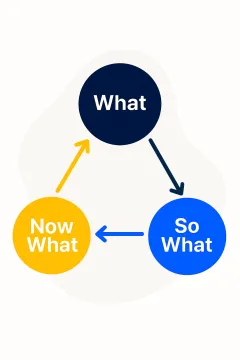
AI Generated Graphic
Applied to reflection on teaching, some possible questions to answer in each of the 3 categories:
What | So What | Now What |
|
|
|
Reference:
Borton. T. (1970). Reach Touch and Teach: Student Concerns and Process Education. McGraw-Hill, New York
Rolfe, G., Freshwater, D., Jasper, M. (2001). Critical reflection in nursing and the helping professions: a user’s guide. Basingstoke: Palgrave Macmillan.
Gibbs Reflective Cycle
While not just for education, Gibbs' (1988) reflective cycle is easily tailored to reflect on an activity, a full lesson, or can scale up to reflect on the unit or entire course.

Some Teaching specific tips for the cycle:
Description - try to record what happened as a neutral observer - what you did and said and what students did and said without any interpretation.
Feelings - recording how you felt at times during the activity or lesson is important, as our emotions can be a good reflection of the things that went well, that we want to adjust, or that we are just not sure about!
Evaluation - be as honest and impartial as possible. It is very important to identify what went well first! Humans naturally default to identifying problems or things that need changing and gloss over what went well and what should continue happening. This also puts us in a more positive mindset which is more productive.
Analysis - again - start with what went well and ID your actions that contributed. Then move on to events that you wish to improve.
Conclusion - start with what you will keep! It is much more manageable to make incremental changes and choose one or two alterations for next time.
Action Plan - Focus on what you can control and influence, and set realistic targets. How will you collect information and assess the changes? Challenge yourself to step outside your comfort zone a little at a time, and see how it works!
References:
Gibbs, Graham. (1988). Learning by doing: a guide to teaching and learning methods. London: Further Education Unit.
https://www.bitesizelearning.co.uk/resources/gibbs-reflective-cycle-explained-diagram-examples
There are many other frameworks that can be employed for reflective teaching practice. Some of the most popular include:
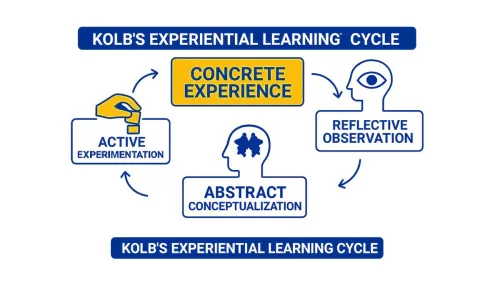
Kolb's Cycle of Experiential Learning
References:
Kolb, D.A. (1984). Experiential learning: experience as the source of learning and development. Englewood Cliffs, NJ: Prentice Hall https://www.nicole-brown.co.uk/reflective-model-according-to-kolb/
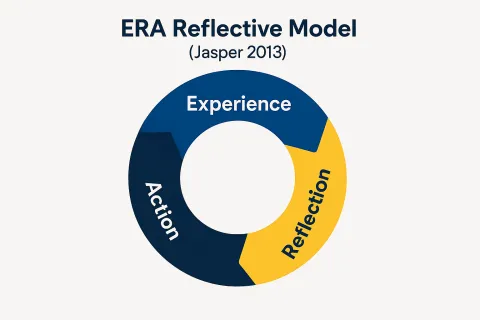
ERA Cycle
References:
Jasper, M. (2013) Beginning Reflective Practice. 2nd edn. Hampshire: Cengage Learning.
https://crowjack.com/blog/strategy/reflection-models/era-cycle
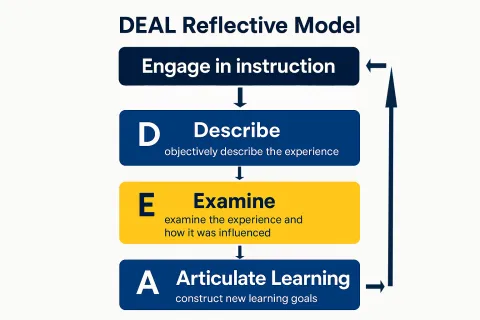
Deal Model
References:
Ash, S. L., & Clayton, P. H. (2009). Generating, deepening, and documenting learning: The power of critical reflection in applied learning. Journal of Applied Learning in Higher Education, 1(1), 25-48.