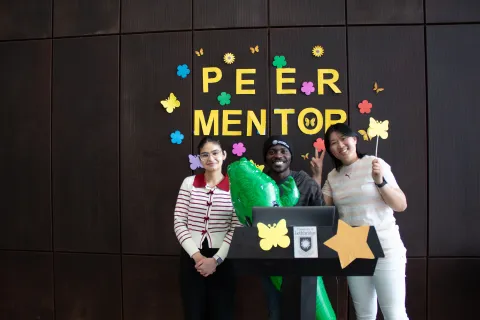
Graduate Peer Mentor Program
Graduate Peer Mentors At A Glance
Each of our amazing Graduate Peer Mentors provides a unique perspective through their own lived experiences. Click on each to learn more about their studies, and why they chose to join the program.
Graduate Peer Mentor Program
Peer leadership, professional development, and graduate community support
The Graduate Peer Mentor Program is a School of Graduate Studies initiative that strengthens graduate student experience through peer‑based mentoring, facilitation, and resource connection.
The program also provides graduate students in mentoring, oversight, and outreach roles with structured professional development, leadership experience, and transferable employment skills.
Program Structure
The Graduate Peer Mentor Program is a self‑supporting graduate program with distinct but collaborative roles:
Graduate Peer Mentors
- Provide one‑to‑one and group peer mentoring
- Normalize graduate experiences and transitions
- Support reflection, goal‑setting, and navigation
- Connect students to SGS and campus resources
- Work within clearly defined boundaries and referral pathways
Oversight Graduate Assistant (GA)
- Coordinates and supports the overall program
- Ensures ethical practice, consistency, and quality
- Supports training, reflection, and professional development
- Acts as a point of accountability and escalation when needed
Outreach Graduate Assistant (GA)
- Strengthens visibility and awareness of the program
- Supports communication, promotion, and engagement
- Helps connect graduate students to mentoring opportunities
- Builds relationships between SGS initiatives and the graduate community
Together, these roles ensure the program remains esponsive, ethical, and sustainable.
Program Goals
The Graduate Peer Mentor Program aims to:
- Support graduate student wellbeing and success
- Normalize challenges across the graduate journey
- Increase awareness and use of SGS supports
- Foster belonging and connection across graduate programs
- Develop graduate students as ethical, inclusive peer leaders
- Create sustainable, student‑led support infrastructure
Training and Professional Development
All Graduate Peer Mentors and GAs engage in ongoing training and reflective practice, including:
- Role clarity and professionalism
- Ethics, boundaries, and referral
- Inclusive communication and facilitation
- Navigating complex or ambiguous student situations
- Program evaluation and continuous improvement
- Career articulation and transferable skill development
Training emphasizes judgment, responsibility, and collaboration, rather than advice‑giving or problem‑solving.
Career‑Relevant Experience
Participation in the Graduate Peer Mentor Program supports development in nationally recognized skill areas, including:
- Professional communication
- Leadership and teamwork
- Equity, diversity, and inclusion
- Teaching and mentorship
- Project and program coordination
The program is intentionally framed as paid, professional graduate experience, not volunteer service.
Who the Program Serves
- All graduate students are welcome to access peer mentoring services
- Graduate Peer Mentor, Oversight GA, and Outreach GA roles are available to graduate students through a competitive selection process
Roles are designed to reflect a range of disciplines, lived experiences, and stages of graduate study.
Graduate Peer Mentors (May 2026 - April 2027)
Alexa Fowler
In your graduate journey so far, what has supported your learning, well‑being, or sense of balance most strongly (academically, personally, or in community)?
Regular exercise such as going for a walk outside, joining a rec sport league, or using the campus gym has been a huge support for both my health and social well-being. Exercise helps me manage stress, maintain focus, and stay energized, while keeping me connected in my community outside of academics, which creates balance in my life.
What motivated you to become a Graduate Peer Mentor, and how do you hope to support a sense of belonging and connection within the graduate community?
I was motivated to become a Graduate Peer Mentor because I know how important it can be to have someone to turn to while navigating graduate school. I hope to help create a welcoming environment where students feel comfortable asking questions, sharing experiences, and knowing that they belong in the graduate community.
What insight, practice, or perspective has helped you grow as a graduate student that you would like to share with others?
Focusing on my personal progress rather than perfection. I feel like grad students often place a lot of pressure on themselves to know everything, but recognizing that no one is expected to have everything figured out and that graduate school is a continuous learning process has helped me to reduce that pressure and has taught me to celebrate the small wins.
Nabeel Al Jahan
Nabeel is currently working on his thesis exploring the historical connections based on Buddhist heritage between the Bengali and Japanese scripts. Beyond his research, he is deeply invested in how we communicate, both as scholars and as a community. Throughout his graduate journey, the strongest support for his learning and well-being has come from the authentic bonds shared with his academic peers. Whether it is navigating complex discussions in the classroom or offering mutual support during personal hurdles, the graduate student community here at the University of Lethbridge has been his anchor. This connection is exactly what motivated Nabeel to become a Graduate Peer Mentor. Having navigated different academic systems in Dhaka, Toronto, and now in Lethbridge, he knows how vital it is to have a reliable point of contact. He hopes to strengthen this sense of belonging by ensuring no student feels they are walking their path alone, acting as a bridge to the resources and community networks that helped him find his own footing here. The most valuable perspective Nabeel aims to share with fellow students is that success in grad school is a balance of time management, clear prioritization, and technical mastery. By finding the right blend of these skills, we can navigate the heavy workload of graduate studies without sacrificing our personal lives. Nabeel believes that with the right combination of strategies and a supportive community, graduate students can manage the demands of academia while staying healthy and connected.
Niosha Attarifard
As a first-year MSc Kinesiology student specializing in biomechanics, my graduate journey has been shaped by a few key pillars of support. My supervisor's guidance on academics and research has given me clarity and confidence in navigating this new chapter.
Advising has also been incredibly helpful, giving me the structure I need to plan my academic life with intention and purpose. On top of that, community engagement has been a wonderful way to find balance, connecting with others outside of my research reminds me that graduate school is about more than just academics.
I truly enjoy helping and connecting with people. Graduate school can feel isolating, especially early on, and I want to be an approachable presence for students who may need someone to talk to, lean on, or simply relate to. Having had the opportunity to access many on-campus resources, I have experienced firsthand how they can make you feel welcomed and like you truly belong. That sense of belonging has meant a great deal to me, and I am eager to give that back to the community I am so proud to live and study in.
One insight that has made a real difference for me is learning to break big goals into smaller, manageable steps. As a graduate student, it's easy to feel overwhelmed by the bigger picture. Taking things one step at a time has helped me stay motivated, reduce stress, and make steady progress, and it's something I look forward to sharing with the students I mentor.
Olympia Tomasta
In your graduate journey so far, what has supported your learning, well‑being, or sense of balance most strongly (academically, personally, or in community)?
Something I have found to be super helpful is attending and taking part in the different conferences, symposiums and graduate events across campus. It is a great way to expand your knowledge and network with fellow graduate students!
What motivated you to become a Graduate Peer Mentor, and how do you hope to support a sense of belonging and connection within the graduate community?
I wanted to become a graduate peer mentor to support graduate students as they navigate this new chapter of their academic life. Graduate school can seem overwhelming at times and I want to provide a welcoming environment in which new students can grow and thrive, by providing information, resources and encouragement!
What insight, practice, or perspective has helped you grow as a graduate student that you would like to share with others?
It is important to prioritize your research and classes as well as to take time for yourself. Finding time to do things for you can be challenging with everything that we do as graduate students but rest is key for having an enriching overall experience (in other words, you do your best work when you are rested and fulfilled 😊). Also, don’t let the imposter syndrome get in your way. You’ve worked hard to get here and deserve your place!
Regina Olarewaju
Regina is an MFA New Media student whose work examines how movement, meaning, and rhythm shift as Yoruba dance is translated into digital form using motion capture. Her graduate journey has been shaped by learning how to balance creative work with academic demands, while also building a sense of community along the way. She became a Graduate Peer Mentor because she cares about creating a more supportive and connected environment for other students. Having experienced moments of uncertainty herself, she understands how important it is to have people to talk to. She hopes to be someone others feel comfortable reaching out to, whether for guidance, reassurance, or simply conversation. One thing that continues to guide her is focusing on progress rather than perfection. She values consistency, openness, and self-compassion, and hopes to share this with others as they navigate graduate school.
Graduate Peer Mentor Program Support
Amanda Ervin
In your graduate journey so far, what has supported your learning, well‑being, or sense of balance most strongly (academically, personally, or in community)?
My learning and well-being have been most supported by strong relationships, both within my academic community and beyond! Staying connected to peers, mentors, and community partners has been the key to sustaining balance and finding joy as a graduate student.
What motivated you to become a Graduate Peer Mentor, and how do you hope to support a sense of belonging and connection within the graduate community?
I was motivated to become a Graduate Peer Mentor because I value the role connection plays in student success. As a seasoned graduate student, I understand how isolating this experience can feel at times. I hope to support others by creating space for honest conversation, shared experience, and a stronger sense of belonging.
What insight, practice, or perspective has helped you grow as a graduate student that you would like to share with others?
One perspective that has helped me grow is recognizing that progress in graduate studies is not always linear. Being adaptable, staying grounded in purpose, and allowing space for both challenge and growth has been essential, and that’s something I would encourage others to carry with them.
Daniela McGonigal-Plankey
Daniela is a graduate student in the department of Indigenous Studies at the University of Lethbridge. Originally from Mexico, she grew up in Calgary and is proud of her Mexican identity and mixed Chilean-American and Scottish heritage with Latin American Indigenous ancestry. Her research examines how Mapudungun is taught online, and how the symbolic and linguistic elements in online language videos reinforce the language learning process. In her free time when she is not thesis writing, Daniela likes to swim, travel, learn Indigenous languages, play music and do lots of creative writing. She also knows some fun facts about early Western Canada that not many people do. She hopes to bring her creativity and ideas towards helping new and current graduate students feel a connection with the campus community, and to get the word out on the amazing work being done by the Graduate Studies department!