
Images of Research 2026
2026 Images of Research Finalists
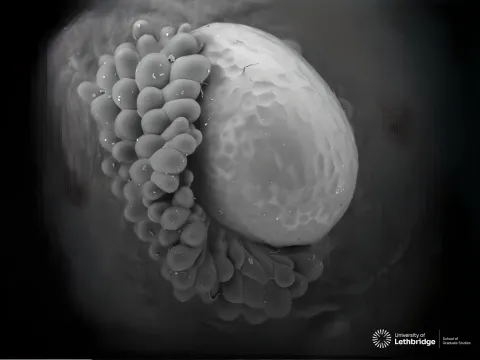
Seed's Eye View
Supervisor: Dr. Jenny L. McCune
Abstract:
Seen at 50× magnification using a scanning electron microscope (SEM), this image reveals the seed of the endangered wood-poppy just 2 millimeters long. The football-shaped seed bears a jelly-like appendage called an elaiosome that attracts ants which disperse the seeds to new locations. Subtle variations in seed form, visible only at microscopic scales, may reflect how Canada’s four remaining populations have evolved in isolation within fragmented forests. My research tests whether genetic differences among populations are linked to trait variation such as seed morphology and plant growth using common garden experiments. Understanding these differences helps guide conservation decisions and addresses a key restoration question: should seed sources be kept separate to preserve unique adaptations, or mixed to increase genetic diversity?
Participant Bio:
I am a PhD student in Biosystems and Biodiversity (ecology major) in the McCune lab. I recently defended my thesis on informing rare plant conservation with experimental translocations and common garden trials. I grew up in Athabasca exploring the boreal forest and have since grown my botanical knowledge through working in the southeastern United States and Canada on rare plant conservation projects.
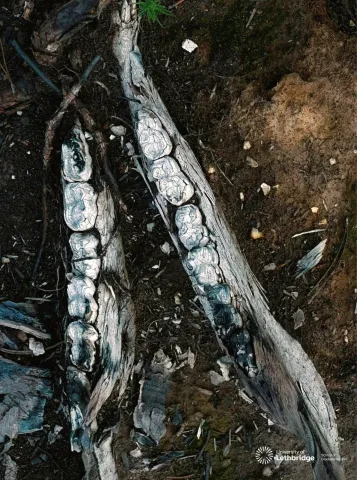
A Burnt Jawbone and a Bright Green Beacon
Supervisors: Laura Chasmer, Raphaël Chavardès, and Hester Jiskoot
Abstract:
Across the charred forest floor lies the jawbone of an elk, killed by the recent wildfire in Jasper National Park. The blaze was so severe that the bone is cracked and brittle, highlighting the extreme impact of this fire. And yet, already new life is emerging. Next to the jawbone, a sapling has sprouted; a bright green beacon of forest resilience.
But how do we foster that resilience? My research involves using lidar-based 3D models to determine the characteristics of areas which experienced the least severe impacts from the 2022 Chetamon Fire. These areas help to protect human communities, promote forest recovery, and act as refuge for animals, saving them from the fate experienced by this elk. By improving our understanding of these fire refugia, we can better manage forests to ensure they are speckled with those bright green beacons of resilience, even in the wake of extreme wildfires.
Participant Bio:
My name is Natalie Krizan, and I am a 2nd year MSc Geography student studying the 2022 Chetamon Fire in Jasper National Park. My project involves using pre- and post-fire airborne lidar data to map forest structures and assess biomass loss due to combustion. Field work is an important part of my research, and it allows me to see the impact of fire first-hand. It is scenes like this burned jawbone and a newly sprouted sapling, where loss and life are so adjacent, that solidify for me the importance and significance of my work.
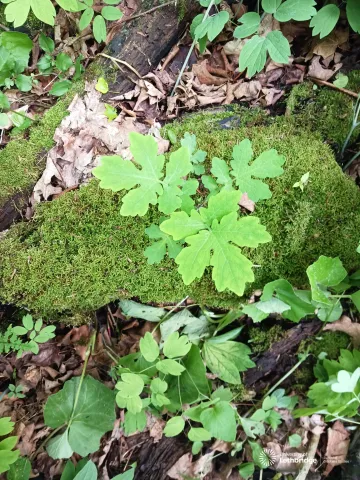
Nature Finds A Way
Supervisor: Dr. Jenny McCune
Abstract:
This wood-poppy (Stylophorum diphyllum) plant has survived for three years on a mossy fallen log. Survival of seedlings is an important contributor to population growth for the wood-poppy; few seedlings survive one year to become adult plants. The wood-poppy is endangered in Canada, with only five known populations, though it is not rare farther south in its range in the United States. I have been tracking individual plants, including this one, at each population for four years, and made a population model to estimate population size changes for three of the populations. I found that that they are not projected to decline, and that seedling survival is an important contributing factor for how the population sizes change. This individual plant, growing in an unusual place, has remained a favourite to observe each summer, as it continues to grow on its perch on a log.
Participant Bio:
I am studying the population demographics of four rare plant species in forests in southern Ontario. I made population models with demographic data from the four species to model the growth rates of each of my study populations. In addition, I am also testing for links between growth rates of two of these species to local and landscape-scale environmental factors to better understand how the environment influences the population changes in these rare plants, which will contribute both to the knowledge of these species and their conservation.
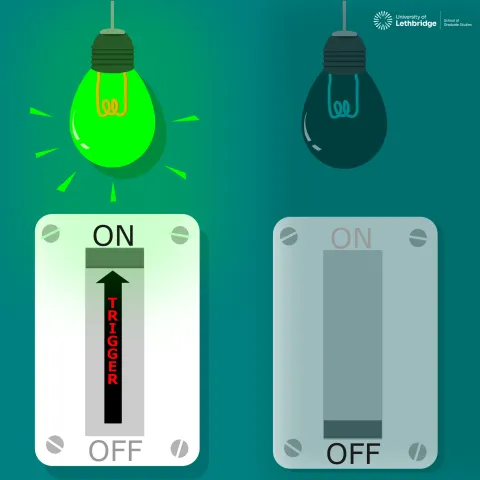
Switching Genes
Supervisor: Jessica A. Willi
Abstract:
A lamp waits unlit in the darkness; it will not shine without a trigger.
Beneath the soil, plant diseases hide in much the same way. Clubroot… a disease that spreads unseen and is often only discovered after the damage has already been done, once established this infection lasts for years causing significant agricultural losses.
Inside a test tube, we build a molecular lamp called a toehold switch. This engineered switch remains folded and inactive until clubroot presents itself. Like a key in a lock, it binds to the switch and unfolds it, producing a visible signal. Like a lamp being lit in the darkness, warning of the disease’s presence.
My research aims to bring this light out of the lab and into the field, enabling early detection to help farmers make more sustainable decisions.
If this disease hides beneath the soil, will we see it in time?
Participant Bio:
I am a biochemistry master’s student working in synthetic biology. My focus is on developing a portable test for detecting “clubroot” a soil-borne disease that infects canola and other brassica type crops. Once soil has been infected the pathogen is extremely difficult to eliminate causing substantial crop loss, early detection is therefore critical. To address this problem, I intend to use toehold switches, engineered RNA molecules that remain inactive until a specific pathogen comes in contact with them, at which point they will produce a visible signal.
Where Method Meets Responsibility
Supervisor: Dr. Janice Victor
Abstract:
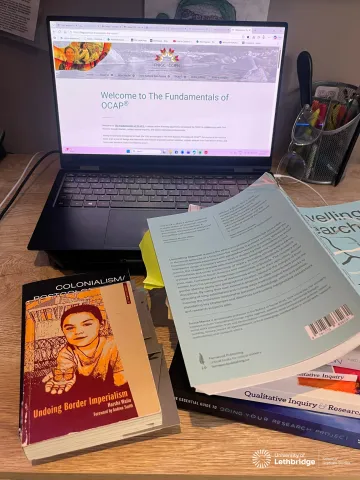
This image captures what research can look like in practice: quiet mornings, slow reading, and the patient work of unlearning. My work sits at the intersection of therapeutic recreation, Indigenous knowledge, and decolonial and community-based approaches, where “knowing” is never neutral and method is always ethical. The books, notes, and OCAP® materials on this desk reflect an ongoing commitment to question inherited truths, sit with discomfort, and take responsibility for how knowledge is gathered, interpreted, and shared. Research here is not about mastery or certainty, but about humility, accountability, and relationship. It involves noticing what feels unsettled, tracing where ideas come from, and asking: who benefits? This image represents research as a daily practice of care: careful reading, careful listening, and careful positioning, guided by a willingness to be changed by what is learned and by those with whom the work is done.
Participant Bio:
I am a PhD student in Cultural, Social, and Political Thought and a Certified Therapeutic Recreation Specialist with experience across community, academic, and nonprofit settings. My research sits at the intersection of therapeutic recreation, Indigenous knowledge, and decolonial and community-based methodologies, with a focus on cultural safety, traditional games, and wellbeing. I’m especially interested in how leisure and recreation can support cultural continuity, social connection, and more just care practices. My work is grounded in collaborative, practice-informed, and interdisciplinary approaches.
A Feline Companion in Learning Mapudungun Online
Supervisor: Dr. Conor Snoek
Abstract:
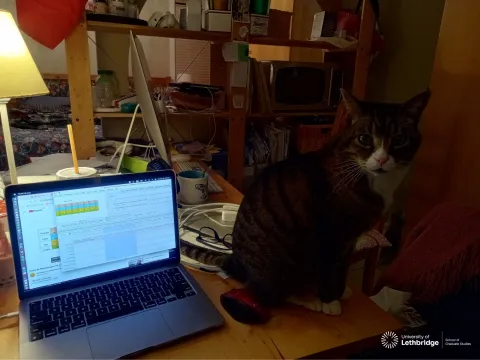
When you're crouched over your computer late at night trying to analyze how a language is taught online, sometimes you just need a funny moment of your cat jumping up onto the table beside you, silently judging you for not paying attention to him instead. When it comes to my research, it's all about trying to see the bigger picture of why an Indigenous language is being taught online, leaving more than enough time to give my cat his cuddles!
Using Thematic Analysis, I create codes and patterns to understand how Mapudungun is taught online. Using a software called ELAN, I created 17 codes to find common patters to answer my research question. My goal with this research is to uncover the symbolic elements within the online videos that create an engaging environment for someone learning Mapudungun online and understand the intent from the instructors in teaching Mapudungun to a wider global audience through YouTube. This photo illustrates the way my cat Hawthorn just wants attention, even when I'm trying to work on my thesis.
Participant Bio:
I am a Master's student in the department of Indigenous Studies. I am studying how Mapudungun, which is spoken in Chile, is taught online, and am conducting an exploratory analysis of an online YouTube series on the language using the methodology of Thematic Analysis. I hope to use this methodology to understand online platforms can be an effective tool to teach Indigenous languages, both in Canada and Latin America. Indigenous languages and history are one of my passions, and I'm very proud to be able to pursue this research and contribute to an issue that is so important right now.
A Recipe for Success: How to Cook the Correct Code
Supervisor: Dr. Marc Roussel
Abstract:
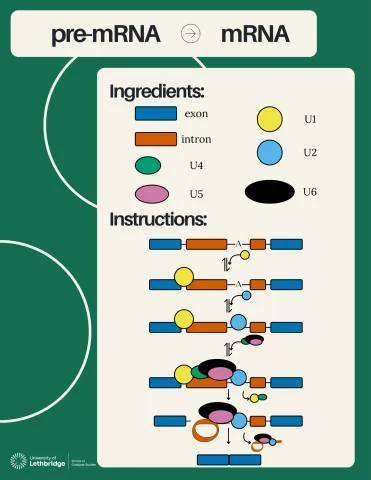
Have you ever found yourself scrolling through an endless abyss of someone's life story when all you wanted was a cookie recipe? And have you ever asked yourself how it relates to your desired snack? Your cells ask the same question of the recipes, or RNAs, that are originally transcribed from your library of DNA. To obtain the correct code to cook a protein, these preliminary recipes are subjected to a process in which, ideally, unnecessary stories are discarded and necessary ingredients are spliced together using a set of biological scissors called the spliceosome. However, sometimes mistakes are made, resulting in the wrong code and a recipe for disaster and disease. Using mathematical models, we can better understand the important steps in the assembly of the spliceosome and the splicing process to provide insights into how some of these mistakes occur, and what we can potentially do to fix them.
Participant Bio:
Elizabeth is a 4th year PhD student in Theoretical and Computational Science who uses mathematical models to better understand human gene regulation mechanisms that have been linked to disease. When they're not participating in teaching or research, you can find them reading and writing books, probably with a cat or two on their lap.

Dichroic Crystals to Molecular Structures
Supervisor: Paul Hayes
Abstract:
Looking at the world around us from multiple angles can provide unique perspectives. In chemical crystallography, we call this dichroism, wherein chemically pure crystals can exhibit entirely different colours upon rotation by even several degrees—this rare feature can be observed under a light microscope, as depicted in the corresponding image, which captures the process of selecting crystals for analysis by X-ray crystallography.
Using a state-of-the-art X-ray diffractometer renders it possible to obtain a molecular image, or “photograph,” which is not possible using other tools. X-ray crystallography is a key characterization technique in synthetic chemistry because unambiguously establishing the 3-dimensional structure of new compounds is essential to visualization, and hence, our understanding of numerous structural properties. Knowledge of some features, such as bond angles and lengths, is vital for predicting and understanding the reaction chemistry of chemical compounds.
Participant Bio:
I am an M.Sc. Chemistry student in the Department of Chemistry and Biochemistry working with Prof. Paul Hayes. My research focuses on the design of cobalt complexes to study fundamental reactions to develop more environmentally conscious routes to value-added chemicals, such as pharmaceuticals and agrochemicals.
Rainbow Science
Supervisor: Nehal Thakor
Abstract:
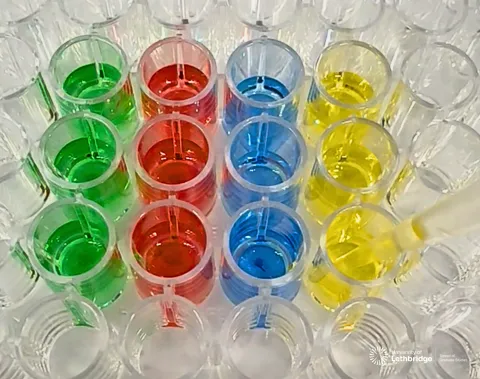
This vibrant 96-well plate represents the colourful reaction steps of a BrdU incorporation assay used to measure cell proliferation. The cells incorporate BrdU; a labelled nucleotide substitute during DNA replication in cell division. In my research, I explore how the protein ‘eIF5B’ affects cancer cell proliferation. Each hue tells a story: green for the primary antibody, red for the secondary antibody, blue for the substrate reaction, and yellow when the reaction is stopped. Far from a dull routine, these vivid transformations make science mesmerising, turning precise lab steps into a rainbow that sparks curiosity and reveals the beauty of discovery. Through this experiment, dynamic visuals inspire wonder while advancing biological research on cancer growth.
Participant Bio:
I am a second year MSc in Biological Science student. My research focuses on cancer biology. I explore how specific proteins affect cancer progression and how to use these proteins as therapeutic targets.
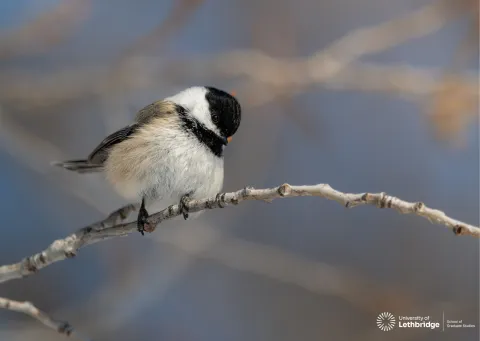
Effects of Forest Fires on the Population Structure of the Black-capped Chickadee
Supervisor: Dr. Theresa M. Burg
Abstract:
The Black-capped Chickadee is a resident songbird widely distributed in North America. As a cavity-nesting species that depends on forest resources for foraging, it is highly dependent on continuous forest structure. So, large-scale disturbance events that dramatically alter forest connectivity can affect their population dynamics and survival.
In recent years, climate change has intensified forest fires by increasing fire frequency and severity in Canada, with events such as the Kenow wildfire burning extensive forest areas. Such disturbances fragment habitats, disrupt landscape connectivity, and ultimately reduce gene flow among populations. This will have negative consequences, lowering the adaptive potential of the species.
My study aims to see how these events have affected the population structure of the species in Southern Alberta. Connecting changes in landscape to genetic structure, my study will help inform the community with post-fire forest restoration strategies and habitat corridor management to maintain resilient wildlife populations.
Participant Bio:
I am Nikeet Pradhan, a young ornithologist from Nepal, currently pursuing my master's in Biological Sciences, focusing on avian molecular ecology in Dr. Theresa Burg's lab. I had worked with tropical birds for the last five years in Nepal, but boreal species in Canada are completely new for me, and I have fallen in love with my research species, Black-capped Chickadees, which are so curious about everything. I am studying the effects of forest fire-induced habitat fragmentation on the population structure of the species.
The Future is Flow
Supervisor: Dr. Dan O'Donnell
Abstract:
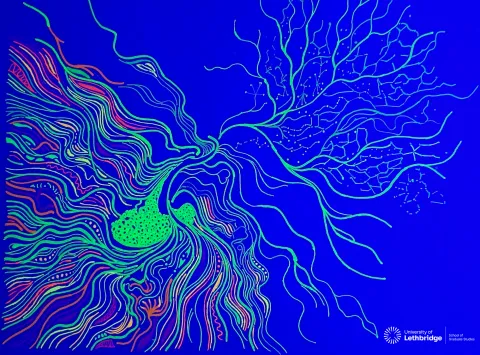
This hand-drawn interpretive illustration visualizes social class through Constructal Theory, which explains how flow systems evolve toward easier movement and greater concentration. In social systems, value flows through labor, information, energy, and capital. The lower left represents diverse human activity generating value across society. These many distributed streams converge into a dense central basin, illustrating the structural accumulation of wealth and power in elite reservoirs. Class is depicted not as a fixed group of people, but as an emergent architecture of value movement and storage. The branching network in the upper right represents artificial intelligence as a rapidly expanding new domain of value creation. Although structurally distinct, its outputs currently channel into the same accumulation center. The black light medium emphasizes intensity, contrast, and flow, interpreting inequality as a dynamic system shaped by evolving technological and economic currents.
Participant Bio:
Shara Merrill is a PhD researcher in Cultural, Social, and Political Thought at the University of Lethbridge. Her work develops Social Thermodynamics, a framework that applies Constructal Theory to social systems. She studies how flows of labor, information, energy, and capital shape patterns of inequality, arguing that social class emerges from the architecture of value movement and accumulation rather than fixed categories of people. Her research focuses on artificial intelligence as a major new flow domain that may intensify or transform these dynamics. Merrill combines theory with visual and interactive research-creation to make complex social systems visible and understandable.