
Images of Research 2024
2024 Images of Research
Divide and Conquer
Supervisor: Dr. Roy Golsteyn
Abstract:
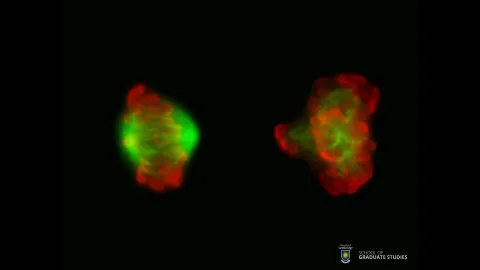
In our bodies, cell division is essential for growth and repair. However, uncontrolled and continuous cell division can lead to cancer. This image showcases a cancer cell preparing to divide (left), with its DNA (red) perfectly aligned in the middle from which the mechanical protein tubulin (green) will divide the DNA into two new cells. Through my research, I have identified natural product compounds from Canadian prairie plants that inhibit cancer cell division. On the right is a cancer cell treated with a Glacier Lily extract, Erythronium grandiflorum, which results in the DNA being misaligned and prevents the cell from dividing—the key objective of anti-cancer treatments. The anti-cancer properties of the Glacier Lily, as well as several other Canadian prairie plants identified in our laboratory, can help scientist to learn more about effective ways to inhibit cancer cell division and work towards developing new medicines.
Participant Bio:
Shannon is a graduate student studying the bio-activities of Canadian prairie plants. This semester, she will be defending her master's thesis titled "Investigating the structure-function relationship of anti-mitotic natural products in Canadian prairie plants".
Magic Touch?
Supervisor: Dr. Robbin Gibb
Abstract:
We know that recent studies from the CCBN have shown that Tactile Stimulation (loving touch) slows the onset of Alzheimer’s disease in aging mice. I want to know if touch can transcend generations. If it can, imagine if we could go back a generation and prevent the disease in the first place.
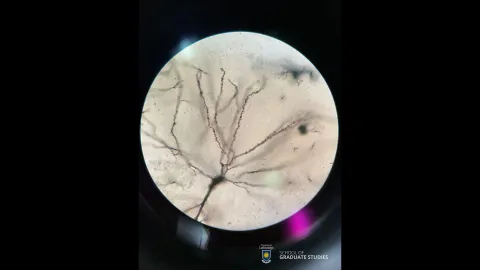
This image may hold the answers. I took this photo through the eye piece of my microscope at 100X magnification. It is a stained brain cell from the offspring of a male rat, who received extra pets 3 times a day for 2 weeks, prior to conception. This cell is in the area of the brain responsible for forming memory and where Alzheimer’s dementia sets in. The bumps or buds along the branches are called spines and each one is where another brain cell connects to ‘’talk” to each other. You are seeing where memories were formed.
Participant Bio:
I am a second year MSc graduate student in the department of Neuroscience under the supervision of Dr. Robbin Gibb. I am a mother of 3, wife and avid volunteer. I am research how pre-conception tactile stimulation in fathers (Long-Evans Rats) prior to conception impacts their babies brains and behaviour.
Journey to the Center of a Flower
Supervisor: Elizabeth Schultz
Abstract:
The food we eat, clothes we wear, and homes we live in all began with a single seed. A flower contains the structures required to make a seed and this process begins with pollen making its journey to the center of a flower.
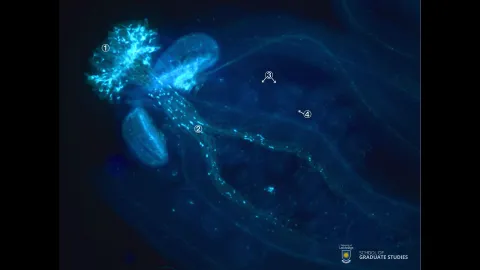
Pollen lands on top of a flower (1), and forms pollen tubes (2) that grow down towards the ovules (3). When a pollen tube reaches an ovule it enters (4) and releases a sperm cell that fertilizes the egg. This process begins the development of a seed which will grow into a new plant.
My research examines genes required for successful seed production in the model plant Arabidopsis to better understand this critical process. We can visualize this by staining a flower with dye and exciting it with fluorescent light, allowing us to see each step of a pollen grain’s journey to ultimately form a seed.
Participant Bio:
Jaxon is a MSc. student working on plant development and genetic research with Dr. Elizabeth Schultz. He enjoys teaching undergraduate students and helping them gain a better understanding of and fascination for biology. He also enjoys continuing to learn about the fascinating world of plants and is thankful for the experiences and many mentors he has had here at the University of Lethbridge.
A Road Less Travelled
Supervisor: Julie Young
Abstract:
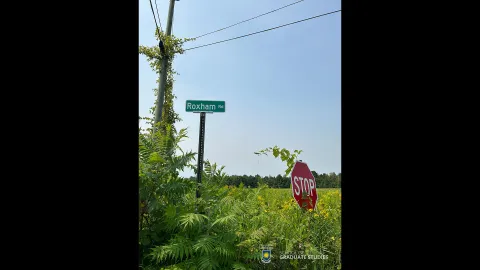
In the summer of 2023, my supervisor and I travelled to northern New York State so that I could complete my field work. One component of this was to visit Roxham Road - an unofficial border crossing between Quebec and New York State. It has been quite prevalent in the media recently as it is a key site for researchers analyzing how border policies impact immigration. For example, from early 2017 to the recent closure of this border crossing in 2023, over 100,000 migrants have passed through Roxham Road, and while I was there, I was informed that it is now rare to see people travelling to the crossing. This information makes the photo of the overgrown road and stop signs an artifact of the impacts of shifting border policies on where migrants are making their journeys between Canada and the US.
Participant Bio:
I am in my second year of my MA in Human Geography and did my bachelor's degree in Archaeology. My research examines how Canada-US border policies affect the interactions between migrants, advocates, businesses, and objects in the border community of Plattsburgh, New York. Overall, my project is on borders and immigration with a supplemental component of contemporary archaeology as I focus on artifacts, such as infrastructure and objects, associated with migration.
Building Executive Functions Through Play
Supervisor: Dr. Robbin Gibb
Abstract:
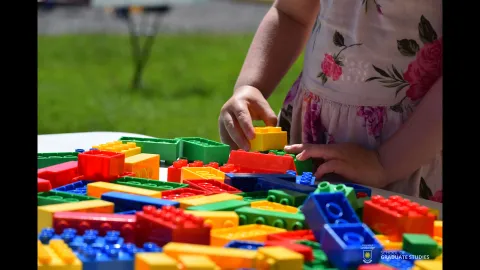
Play is essential for children! Whether it's running through the grass or constructing a lego mansion, play allows children to test boundaries, develop executive functions and be creative. My research tests different curricula to determine whether they are effective interventions for children's executive functions. One of the games involved in both the children and adolescent's curriculum involves lego. While working with my supervisor's organization, Building Brains Together, over the summer, we get the opportunity to build executive functions through playing with kids! This image is a young girl that came to our events multiple times and was always drawn to the colorful lego.
Participant Bio:
I am a Master of Science, Neuroscience student, and I work in more of an educational psychology space. My work focuses on testing interventions for youth executive functions, and one of these activities involves lego! Not only is lego a part of of the game curriculum, but it's also part of the testing. Dr. Claudia Gonzalez's lab developed a lego motor task that is used to look at handedness in relation to executive functioning capacities. Through our work with Building Brains Together, our lab gets the fantastic opportunity to play with lego with kids of all ages!
Plant hula hoop
Supervisor: Dr. Jenny McCune
Abstract:
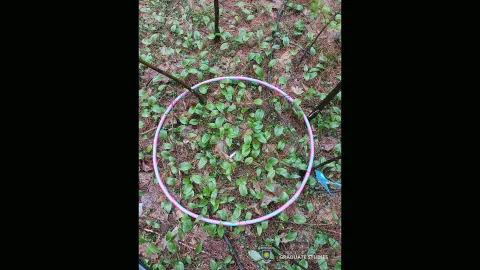
A hula hoop, centered on a spotted wintergreen (Chimaphila maculata) plant (marked by a flag) in a forest fragment in southern Ontario, can show how dense plants grow around a spotted wintergreen. The spotted wintergreen is a small woodland plant, with dark green leaves that have a white stripe down the middle. It is rare in Canada, and research on the viability of known populations and environmental effects on population change can contribute to conservation of the species. Plant density can influence population growth rates, while knowing what species occur in close proximity to the spotted wintergreen can provide information on what plants typically grow in the same environment. In addition to plant density, I’m also collecting census data on some of these individual plants and environmental data including light availability, to model the population growth rates and whether environmental factors influence population growth rates.
Participant Bio:
I am studying the population demographics of four rare plant species in forests in southern Ontario. I will construct population models with demographic data from the four species to model the growth rates of some populations. I will also link the growth rates to local and landscape-scale environmental factors to better understand how the environment influences the population growth rates of these rare plants, which can contribute to both the knowledge of these species and their conservation.
Star of the Woods
Supervisor: Dr. Jenny L. McCune
Abstract:
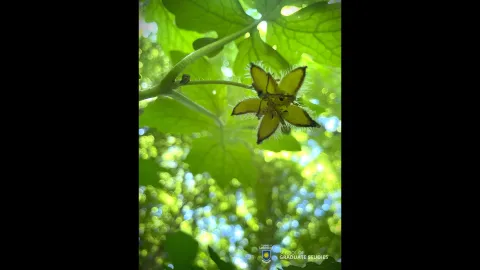
Exploding like star in space, the hairy fruit of the endangered wood-poppy bursts open, exposing tiny seeds. The seeds symbolize opportunities for this species to spread. The ants invade the vicinity of the plant and abduct the seeds, harvesting the attached jelly-like treats. Unintentionally, they serve the plant by dispersing the seeds in the process. However, wood-poppy’s habitat is now reduced to tiny islands of green due to land conversion, making it a challenge to breach new territory. My research tests experimental re-introductions into unoccupied habitat to help secure its future. Monitoring my plantings I found wood poppy will survive in a wide range of habitat suitability. Therefore, maybe the seeds just need a bigger helping hand than the ants to get around. If we can increase the number of populations, we can reduce its’ extinction risk and keep this star of the woods from burning out on our planet.
Participant Bio:
I am a PhD candidate studying ecology in the McCune lab. My research focuses on rare plant conservation and experimental translocation (re-introductions) in southern Ontario. I grew up in Athabasca, Alberta and have always enjoying being outdoors. My project gives me the opportunity to live the naturalist dream and spend my summers conducting field work in the woods, while making an impact for plant species at-risk.
Lighting Up Learning
Supervisor: Bruce McNaughton
Abstract:
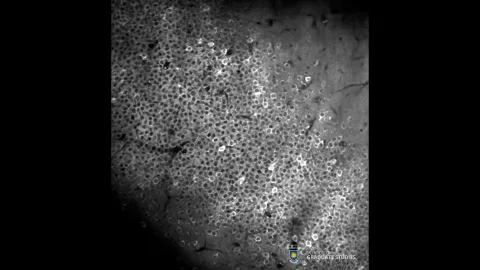
The intricate workings of our brain's memory systems allow us to store and recall information from our environment helping us react appropriately. This image shows the activity of CA1 hippocampal neurons, in a mouse navigating a belt, guided by cues that lead to a water reward, with neurons firing at a specific location each time creating a map of memory in action. This phenomenon is made visible through a modified protein that fluoresces when calcium enters cells, highlighting neuron firing. Captured using two-photon microscopy this image not only demonstrates advancements in neural imaging but also reveals the dynamic interactions within our brain network during learning tasks. My research aims to study the neural underpinnings of memory formation and explore how these processes deteriorate with age or due to neurodegenerative diseases, offering insights into preserving cognitive functions.
Participant Bio:
I enrolled in a Ph.D. program in Neuroscience (fast-tracked from Master’s) at the University of Lethbridge in 2021, under the supervision of Dr. Bruce McNaughton, where I conduct two-photon calcium imaging to monitor neuronal activities and population dynamics in awake and behaving mice. My current work focuses on understanding the hippocampal -cortical interactions underlying memory consolidation and retrieval in mice.