
Images of Research 2025
2025 Images of Research
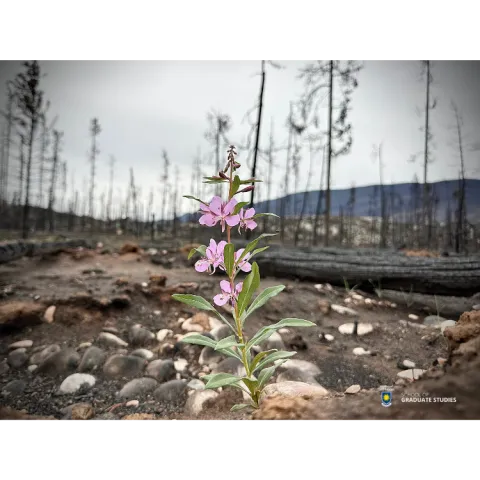
Fireweed Phoenix
Supervisors: Laura Chasmer (ULeth) & Raphaël Chavardès
Abstract:
Amid the severe destruction on this fire-ravaged landscape, regrowth can already be seen. A beautiful purple flower, fireweed, rises like a phoenix from the ashes. It sprouts in the wake of disturbances, signaling the start of the forest’s recovery.
The forests in Jasper National Park are fire-adapted, meaning fires are rejuvenating and promote natural cycles of growth. But fires here are changing. A century of fire suppression and exclusion has altered the condition of these forests, resulting in recent fires burning more severely compared to the past.
My research aims to map that burn severity using lidar-based measurements of the amount of forest biomass consumed during the 2022 Chetamon Fire. This will then be compared to that fire history to determine whether modern fires pose a risk to forest recovery. Will the fireweed phoenix rise? Or will it be smothered by the ashes of high severity fire?
Participant Bio:
I am an MSc Geography student in Dr. Laura Chasmer's lab, and I am studying the 2022 Chetamon Fire in Jasper National Park, Alberta. I am mapping its burn severity using pre- and post-fire
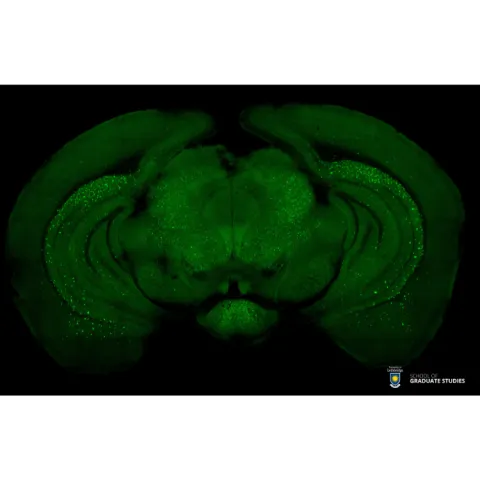
Glowing Warning
Supervisors: Dr. Majid Mohajerani & Dr. Robert Sutherland
Abstract:
At first glance, these glowing spots resemble stars scattered across a clear night sky. But they are far from celestial. Captured from the brain of a mouse model of Alzheimer's disease using two-photon tomography, these luminous dots are amyloid beta plaques—one of the earliest biological signs of Alzheimer's. These seemingly beautiful formations mark the onset of a devastating process that strips away memory, cognition, independence, and ultimately, life itself. These plaques are associated with neuronal degeneration and neuroinflammation, key pathological features of Alzheimer's disease.
Participant Bio:
This is Atabak Ebrahimi Rikan. I earned my bachelor's in physics back in my home country, Iran, then I joined Mohajerani's lab at the University of Lethbridge to do my master's degree in neuroscience. My research project mainly focuses on Amyloid beta plaques deposition in Alzheimer's mouse model brains. My purpose is to explore where and when the plaques form inside the brain and how they progress through the brain regions.
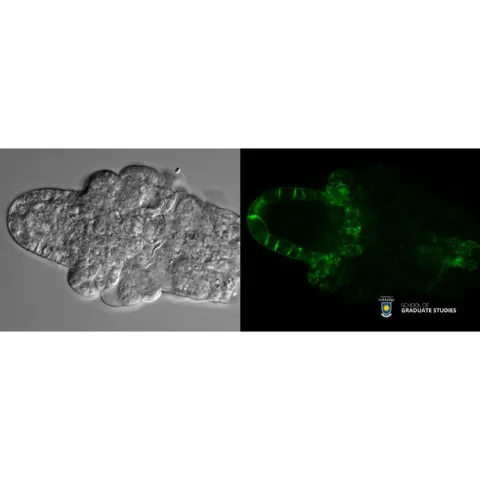
"Bright" Beginnings: The Path from Ovule to Seed
Supervisor: Elizabeth Schultz
Abstract:
No matter how small, each plant plays a crucial role in human life and the planet’s ecosystem, and each plant begins with a seed. Seed formation starts in a flower, and the development of an ovule is the first step in this process.
This image shows an ovule in early development, no larger than the diameter of a human hair. Despite its small size, it holds great potential, and its growth is carefully regulated by a complex network of genes.
The green color in the developing ovule comes from the Green Fluorescent Protein (GFP), originally derived from a jellyfish. When exposed to ultraviolet light, GFP emits a brilliant green glow.
GFP allows scientists to track specific proteins inside living cells, providing insights into where and when these proteins are active. In plant ovules, GFP helps identify crucial genes for seed development, offering a closer look at the “bright” beginnings of life.
Participant Bio:
Jaxon is a MSc. student working on plant development and genetic research with Dr. Elizabeth Schultz. He enjoys teaching students and helping them gain an appreciation for biology. He also enjoys continuing to learn about the fascinating world of plants and is thankful for the experiences and many mentors he has had here at the University of Lethbridge.
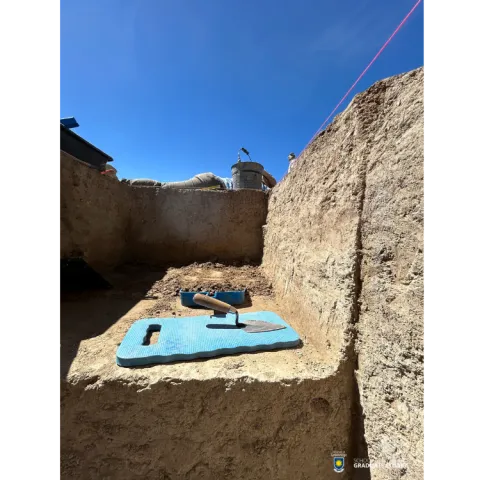
Excavating at Head-Smashed-In Buffalo Jump
Supervisors: Dr. Kevin McGeough & Dr. Julie Young
Abstract:
During the summer of 2024, I volunteered at the University of Lethbridge's Archaeological Field School at Head-Smashed-In Buffalo Jump. This photo is showing the unit that a friend and I were excavating, in an area of the site called the Processing Area. Here, we look for bison bones, projectile points, and other evidence of past human occupation. The trowel in the photo is the main tool we use to dig through the layers of sediment to find these artifacts. Later, the artifacts are moved to the Uleth Archaeology Lab where we analyze and catalogue them with the goal of understanding the lives of past people who used the buffalo jump. I took this photo from 1.5 metres underground in a previously excavated unit from the 2021 field season, of which I had also participated in as an undergraduate student.
Participant Bio:
I am completing a Master of Arts in Geography and have a Bachelor's degree in Archaeology. I have combined these two disciplines to research objects that migrants interact with and leave behind between the Quebec/New York State border. I often spend my summer's doing archaeological field work with students and professors in the department at Head-Smashed-In Buffalo Jump and elsewhere.
Seedlings for Conservation
Supervisor: Dr. Jenny McCune
Abstract:
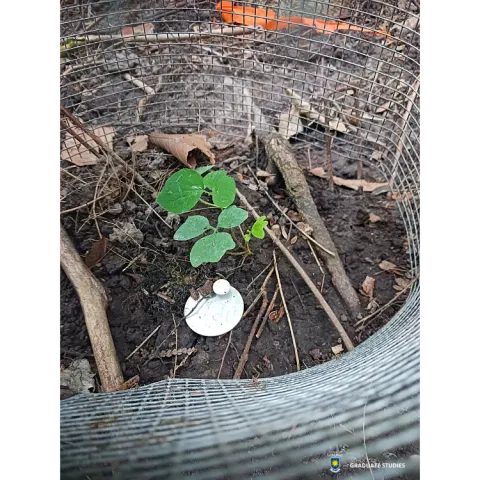
A wood-poppy seedling in a protective cage that survived from June to at least August of last year. Survival of seedlings is an important contributor to population growth for the wood-poppy; few seedlings survive one year to become adult plants. The wood-poppy is endangered in Canada, with only 5 known populations, though it is not rare farther south in its range in the United States. Most of the wood-poppy populations in Ontario are increasing. A population model I made to estimate population size changes shows that they are projected to continue to increase or at least remain at a consistent size, and shows that seedling survival is an important contributing factor in how the population sizes change. One population, represented by this seedling, is declining.
Participant Bio:
I am studying the population demographics of four rare plant species in forests in southern Ontario. I will construct population models with demographic data from the four species to model the growth rates of some populations. In addition to this, I will also link the growth rates to local and landscape-scale environmental factors to better understand how the environment influences the population changes in these rare plants, which will contribute both to the knowledge of these species and their conservation.
Hidden in Plain Sight
Supervisor: Dr. Jenny McCune
Abstract:
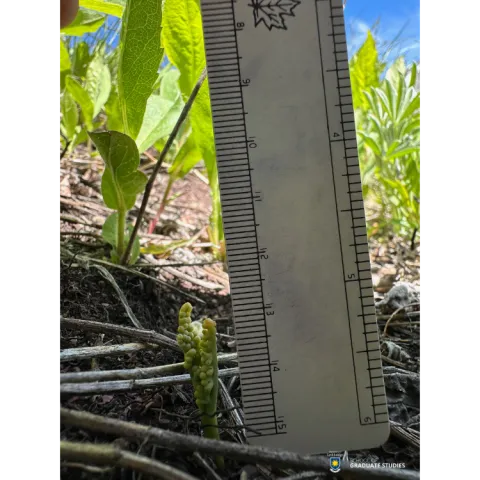
All plant species, no matter how small, must be accounted for during plant community surveys. These surveys help ecologists understand how environmental conditions shape species distributions. Identifying key habitat variables allows us to move beyond describing species where they are, to predicting other locations they might be found. Rare species, like the Botrychium paradoxum shown in this image, may require more specific environmental conditions to thrive, making them potential indicators of rare plant communities. This species is only known in Alberta from Waterton Lakes National Park and Cypress Hills Interprovincial Park, highlighting the need for thorough surveys – this 3cm plant is easy to miss but provides critical ecological insights. My research explores methods to map rare plant communities in Waterton and assess whether rare species like B. paradoxum are indicators of where rare communities occur. Protecting these communities starts with understanding their composition and the variables that influence their distribution.
Participant Bio:
Carisa is a M.Sc. student working on testing different predictive modelling methodologies to help inform plant conservation efforts in Waterton Lakes National Park. She enjoys sharing her love of biology with all who will listen and teaching people how to identify the plants you see when on a hike.
Modular Horizons: Shaping Lethbridge's Housing Future
Supervisors: Dr. Wei. Xu and Dr. Ivan Townshend
Abstract:
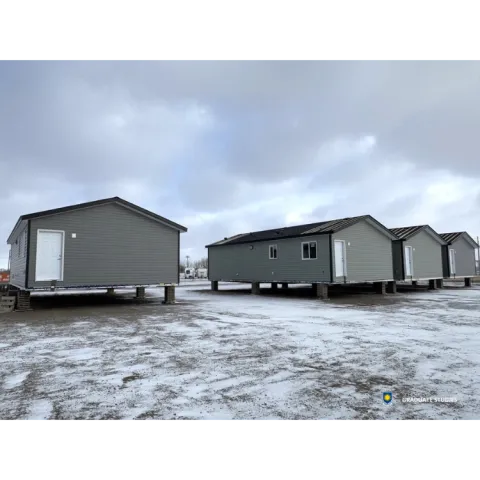
This researcher-created image depicts a view of SRI Company mobile homes in Lethbridge, reflecting a forward-thinking approach to housing documented during data collection and fieldwork. Given Canada’s emerging housing challenges, this study examines the importance of modular, prefabricated, and industrialized housing in addressing these needs, particularly in communities like Lethbridge. Given Canada’s vast geography and diverse housing needs, modular, prefabricated, and manufactured construction, including ready-to-install modules, represents an increase in speed and efficiency in the construction industry. This approach, by leveraging manufacturing innovations, offers rapid and cost-effective solutions to meet the growing housing demand. Specifically, this study analyzes the economic, social, and environmental implications of using modular technologies in Lethbridge. By examining factors such as reducing construction time, minimizing waste, and improving affordability, this research will inform policymakers and promote sustainable housing solutions that meet the evolving needs of the city and the broader Canadian landscape.
Participant Bio:
Clara Khosravizad, a second-year Master's student in Urban and Regional Studies at the University of Lethbridge, is investigating innovative housing solutions for Lethbridge, Canada. Her research focuses on manufactured, modular, and pre-fabricated housing as potential answers to the city's affordable housing challenges. Clara explores various forms of these innovative housing types, including mobile homes, panelized housing, volumetric modular construction, and pre-engineered housing. By examining these alternatives, she aims to contribute to addressing housing insecurity and affordability in Lethbridge, aligning with recent municipal and provincial efforts to increase affordable housing options in the city.
Exploding elaiosome!
Supervisor: Dr. Jenny McCune
Abstract:
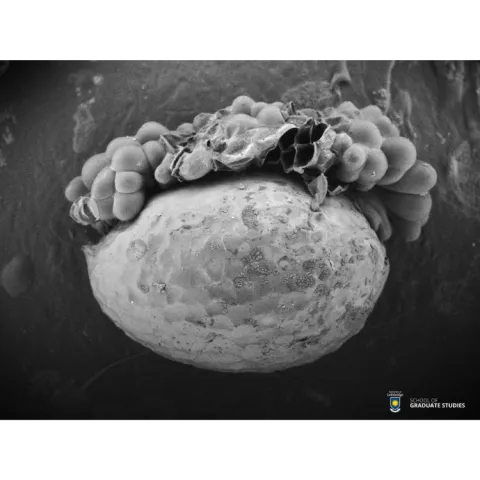
You may be wondering what you are looking at? This isn’t a tiny football wearing a bubble hat, its' the seed of the endangered wood-poppy (Stylophorum diphyllum) seen under the lens of a scanning electron microscope (60X magnification). The structure attached to the seed that looks like a series of tiny bubbles is an elaiosome. Each ‘bubble’ is filled with lipids and proteins which attract ants, who disperse the seeds. In this image you can see a few exploded elaiosome cells. My research examines morphological (physical) differences between the Canadian wood-poppy populations, which are genetically distinct from one another. My work will inform conservation translocations, which are the movement of a species within or outside its indigenous range. To help with species recovery, I am looking for physical differences between seed size and weight to quantify the best populations to source wild seeds from for future plantings.
Participant Bio:
I am a fifth-year PhD student in the McCune lab majoring in Biosystems and Biodiversity. My project involves collaborating with partners on rare plant species in southern Ontario and informing species recovery work through experimental conservation translocations, plant community surveys, and common garden experiments. I previously worked as an intern for the National Tropical Botanical Garden in Hawaii and most recently as a conservation horticulturist at the Atlanta Botanical Garden in Georgia (USA) where I gained my interest in to help save plants in the wild before returning to pursue my degree at the University of Lethbridge.
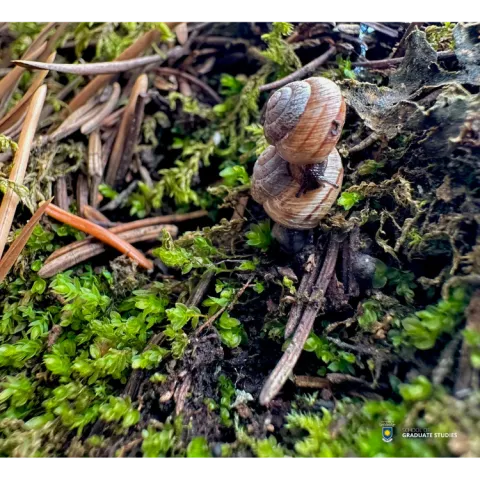
Snails in Full Spring
Supervisors: Dr. Cameron Goater and Dr. Jenny McCune
Abstract:
In a burst of activity spurred on by late spring rains two Black Hills Mountainsnail (Oreohelix cooperi) individuals find each other on a remote forest floor. The range of this endangered species of terrestrial snail is limited, within Canada, to the elevated plateaus of Cypress Hills Interprovincial Park, Alberta. Little is known about the habitat requirements of the Black Hills Mountainsnail, nor is its distribution within Cypress Hills Park well understood. The goal of my research is to develop species distribution models to define the critical habitat and predict the potential distribution of this species. this research will inform critical management decisions in Cypress Hills Interprovincial Park regarding the protection of the Black Hills Mountainsnail and its environment and has the potential to bolster the capabilities of further investigation into this poorly understood species. My hope is that this research will contribute a shell of a lot to their conservation.
Participant Bio:
I am a first year MSc student studying the habitat and distribution of the Black Hills Mountainsnail (Oreohelix cooperi) under the supervision of Dr. Cam Goater and Dr. Jenny McCune. I grew up in Alberta and have always enjoyed the outdoors. I could not be happier to spend much of my time in the summer outside exploring and interacting with the natural world, and I am thoroughly honoured to have the opportunity to contribute to ecological research and conservation in this province.
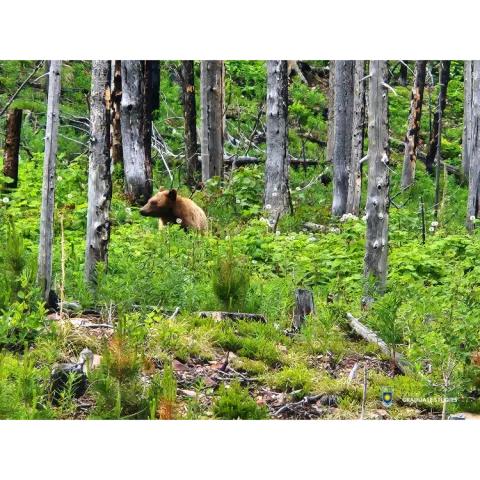
Life Finds a Way
Supervisor: Chris Hopkinson
Abstract:
Mountainous ecosystems support a vast array of plant and animal life, and they provide a multitude of ecosystem services, from supplying water to allowing people to appreciate the beauty of the natural world.
Wildfires can occur in mountain ecosystems, and sometimes these fires remove nearly all live vegetation from the area, leaving only skeletons of trees, blackened earth, and reduced ecosystem functionality. This was the case in Waterton Lakes National Park in 2017.
However, ecosystems can recover from severe wildfire when given enough time. First, annual flowering plants and grasses return, followed by coniferous seedlings, and new green vegetation starts to cover the forest floor. While the sun-bleached tree trunks are evidence of the highly severe fire eight years ago, a community of species, including pine seedlings, thimbleberry bushes, and the brown-coloured black bear shown here, find a way to rebuild the ecosystem in this beautiful national park.
Participant Bio:
I am a master’s student in the department of geography and environment in Dr. Chris Hopkinson’s lab, and I use lasers (lidar) to measure vegetation and snowpack in post-fire mountain environments! I have always loved exploring the Alberta Rocky Mountains, and this environment is what inspires my research. I love hiking, working with geographic technology, and working on deeper understanding of the connections between the natural world and human society. My project specifically relates to quantifying the connections between ecosystem disturbances and water resources, which are critical for regions that depend on mountain headwater supplies, including Lethbridge.
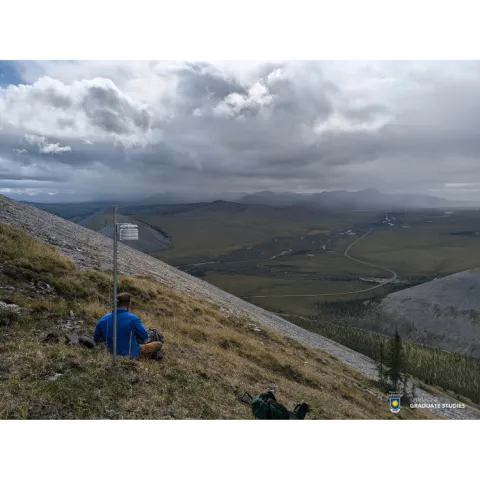
A Man in His Element
Supervisor: Philip Bonnaventure
Abstract:
This photograph is of my supervisor, Philip Bonnaventure, who has inspired me to study surface-based inversions (SBI) in high-latitude mountain valleys in the Canadian Arctic – specifically in the Yukon. A strong correlation exists between the distribution of SBIs and the extent of permafrost in these regions, significantly influencing the cryotic features of the landscape. Using air temperature data collected from microclimate stations (like the one we see Phil leaning up against in this photo), I hope to determine the frequency of extreme cold events within these mountain valleys, and to understand their influence on the occurrence, strength, and depth of SBIs. This study will also include the creation of a predictive model to determine the probability of SBIs at various elevations and temperature thresholds (-40°C, -30°C, -25°C, etc.), while accounting for associated meteorological conditions, climatic events, and synoptic systems.
This is a nod to Phil – a man in his element.
Participant Bio:
I got roped into a master's degree with promises of a good time. Following two sessions of Yukon adventures, I would say that good times have been achieved. Now bring on the pain!
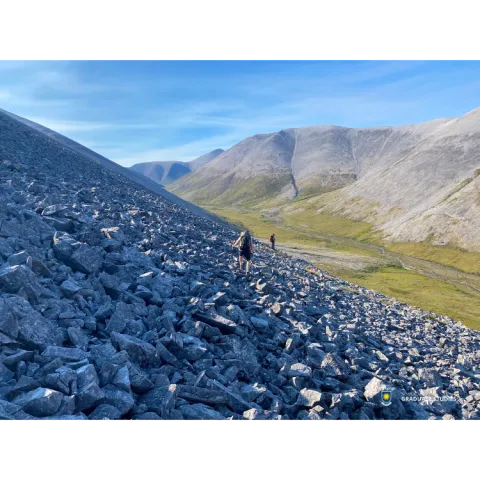
Traversing Blockfield Slopes in Yukon
Supervisor: Philip Bonnaventure
Abstract:
This photo is of our field team hiking in one of the valleys we have air and ground temperature sensors deployed. These sensors are used to determine the distribution of permafrost throughout the landscape and the susceptibility of that permafrost to thaw as the climate warms. The valley pictured in the photo has a very unique landscape that we have to hike over to visit all of our sites. The photo illustrates us walking across the unforgiving blockfield slope to our sites. This terrain is very difficult to traverse but the views while hiking are amazing to take in.
Participant Bio:
I am a PhD student in the department of Geography and Environment. My research is field based and takes place in the Yukon. I study air temperature patterns in mountain valleys. These temperature patterns are dominated by something called a surface-based air temperature inversion. This means that lower elevations in these valleys have colder mean annual air temperatures than higher elevations. This impacts the distribution of permafrost in this region.