
University of Lethbridge Interdisciplinary Research Funding (IRF)
OVERVIEW | |
| Value |
Stream 1: $5000
Stream 1 Special Call: $5000
Stream 2: $12,500 (includes $2,500 matching)
|
| Duration |
Stream 1: 12 months from the start of the award
Stream 2: 18 months from the start of the award
|
| Competition Opens | April 1, 2026 |
| Application Deadline* | Stream 1 Special Call: May 29, 2026 Stream 1 & 2: June 1, 2026, 4:00 p.m. MDT (Annually occurs on June 1)* |
| Notice of Decision | August 2026 |
| Start date | Anytime after August 1, 2026 |
| ORIS Contact | oris.internal@uleth.ca |
| Cover page for application in InfoEd: | Document
|
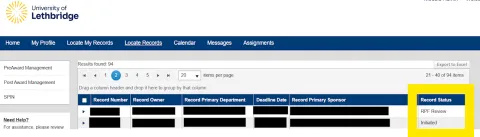
| In INFOED: You MUST CONFIRM THAT YOUR APPLICATION STATUS IS "RPF Review" and NOT left in "Initiated". See instructions below to confirm that you successfully submitted your application by the deadline. See go.uleth.ca/infoed for more information on how to submit. | |
* If a deadline falls on a weekend or a public holiday observed in Alberta, the deadline will be 4:00pm MDT the next business day
Description:
The Interdisciplinary Research Funding initiative supports the formation and advancement of research teams composed of members from diverse academic disciplines and external partners. A minimum of three uLethbridge researchers are required to form a research team. To encourage collaboration among faculty members from different Faculties and Schools at uLethbridge, two funding streams are available to support team development and support grants that require diverse expertise, knowledge, and methods; Stream 1: Research Team Creation, and Stream 2: Grant Proposal Preparation and Development.
Stream 1: Special Call details can be viewed in the dropdown menu below.
We support collaborations that include external researchers, industry partners, and community stakeholders.
2026 is the first year uLethbridge is offering this award. There is one award available for Stream 1 and one award available for Stream 2.
Background
Across campus, there is a growing diversity of funding opportunities, new partnerships and collaborations, and provincial/national priorities that can create tension amongst colleagues as well as with our community partners. For some academic staff, these are opportunities to expand their research programs and student experiences; for other academic staff, these represent real areas of conflict and concern about the academy’s place and positionality.
Leaning into our institutional values, as stated in the Strategic Plan (access, quality, belonging, sustainability, relationships, respect, courage), how does our academy navigate those tensions and differences that arise during research development and dissemination?
One clear and present example of these tensions is related to Government of Canada priority-setting around defense and dual-use research investments and programming. Dual-use activities, research, and development work “...refers to goods, services, or technology with both legitimate commercial/civilian applications and potential military or intelligence use (National Research Council of Canada, Industrial Research Assistance Program)".
Using defense and dual-use research as a case study, we are seeking an interdisciplinary research team (as defined in the Interdisciplinary Research Fund Stream 1 Research Team Creation purpose and eligibility section) to prepare a series of information gathering activities, data analysis, and outcomes report. We strongly encourage proposals to be inclusive of equity deserving researchers.
At the University of Lethbridge, current capacity and activities in both defense and dual-use research include such activities as neurosciences methods development (e.g., concussion, brain trauma), remote sensing technologies, virtual reality and interactive multimedia, AI and cybersecurity, quantum foundations and technologies, space and astrophysics research, health and genetic impacts of space travel, intergenerational trauma and mental health, agriculture technologies and food security, environmental remediation and water security (access, quality), Arctic sovereignty and Indigenous knowledge (ecological, cultural, historical), and more.
The IRF research team will endeavor to describe how an inclusive community of scholars defines, supports, and facilitates safe, ethical, independent, and rigorously tested research in times and topics of conflict. The IRF team should be prepared to be both learners and leaders throughout this project.
At a minimum, the interdisciplinary research team will:
Prepare and disseminate a survey on approaches and recommendations for ethical intersections of faculty-led research independence
Complete analysis of survey data to be used in both a preliminary report and in framing a World Café experience
Aggregated survey response data will be made available on SharePoint for any academic staff member to review and make use of with permission of the research team
Plan and host a World Café on campus, in collaboration with the VPR who will commit to supporting and securing a neutral facilitator for the event
Prepare a comprehensive report on the outcomes of the survey and World Café for collegial review, comment, and dissemination to campus
Prepare recommendations to the VPR on best practices for supporting academic freedom in research and faculty-led inquiry
Proposals are due: May 29, 2026
The IRF allows for projects of up to 12-months in duration. No extensions to time or funding will be permitted.
In the case of multiple excellent project proposals, the VPR may ask applicants to consider combining their proposals.
Purpose and Support
Stream 1 of the IRF is designed to assist uLethbridge researchers in forming new research teams. These teams must be Inter-Faculty/School and interdisciplinary, involving members from different academic disciplines. External partners are welcome, including industry, non-profit, and faculty outside of uLethbridge. Funding is intended to facilitate the development of a strong interdisciplinary team with a shared vision for either/both Stream 2 funding and/or extramural grant applications, such as the New Frontiers in Research Fund program. Teams must demonstrate the benefits of bringing disciplines together to explore new ideas with potential for significant impact.
Eligibility and Requirements
To qualify for Stream 1 funding, research teams must consist of at least three researchers (full-time or a tenure track position) from distinct disciplines. At least 1 team member must be from a different Faculty or School and at least 2 of the 3 broad categories of research activity must be represented (health disciplines, social sciences, humanities and fine arts, sciences). This requirement ensures genuine interdisciplinary collaboration and broadens the scope of expertise within the group.
Eligible research activities may include support to host a writing workshop for team members, engagement of research student(s), collection or production of preliminary data or information required to demonstrate proof of concept (pilot study to test the idea) and/or compete for extramural funding, honoraria for Elders and community volunteers, and similar expenses related to the development of a new collaborative research program or project.
A recommendation from the Dean or Associate Dean responsible for Research is essential.
Funding Details
The maximum RTC award is $5,000.00. and is provided for a period of one year. Applicants must include a comprehensive budget section in their proposal, outlining both RTC and Faculty/School support.
Purpose and Support
Stream 2 provides funding to uLethbridge researchers who are leading interdisciplinary research teams in the preparation and submission of significant external collaborative grants. This stream is specifically designed to support team leaders and members in the ideation and creation of grant proposals for major external funding competitions, such as NFRF-Transformation, NSERC Alliance, CFI Innovation Fund, Horizon Europe, and Discovery Horizon. Success in Stream 1 funding is not a pre-requisite for Stream 2 applications. Adding external partners in the research team is encouraged, including industry, non-profit, and faculty outside of uLethbridge.
Eligibility and Requirements
To be eligible for Stream 2 funding, research teams must consist of at least three uLethbridge researchers (full-time or a tenure track position) from distinct academic disciplines. Applications where team members have a record of prior collaboration will be viewed favourably. In most cases, inclusion of external partners, whether academic, community, and/or industry, is an asset for interdisciplinary/transformative grant development.
Funding Details
The maximum award available through Stream 2 is $12,500.00, which includes $10,000.00 from OVPR and $2,500.00 contributed by the Faculty(ies)/School(s) involved*. The funding is provided for a period of no more than 18 months. Applicants are required to submit a comprehensive budget section in their proposal that details both RTC and Faculty/School contributions.
*If the research team consists of members from multiple faculties, the faculties should agree to each contribute to the matching funds so that they provide a minimum of $2,500 total towards the proposal.
Submit your application through InfoEd as an Research Proposal Form- Internal Award. In InfoEd, complete the RPF, and attach the following documents.
For the attachment, use font size of 12 point, black type. Maximum of six lines per inch. No condensed/narrow fonts, type, or spacing. Insert a margin of 2 cm (3/4 inch) minimum around the page.
Application Package (same as the link at the top of the page, 8 pages maximum).
The application page includes:
Names, position, and department of each team member
Additional trainees (and their supervisors’ names)
Proposal Title
Proposal Abstract
Provide a succinct project description written so that a non-expert in the field of study can understand the proposed research, the scope and objectives of the project. Also outline the potential significance of the study to the University, discipline, researcher, students, and/or society at large.
Key words
At the end of your Abstract, provide a list of up to 10 key words which describe your research project. These words can include: themes; areas of research or creative activity; objectives; methods/approaches; study populations/experimental systems; and outcomes, among others. The Key Words will assist the Multidisciplinary Review Committee in gauging their level of expertise in reviewing your proposal.
Budget chart (budget items and justification)
The justification should:
Explain how the costs were established for each item in the budget
Describe and justify how the funds will be used to recruit the members of the interdisciplinary team
Contribute to the direct costs to recruit members for the interdisciplinary team and to develop research project
Show economical use of the funds
Research Proposal (Stream 1: three page maximum/ Stream 2: five page maximum):
The proposal should explain why an interdisciplinary approach is required, or how this approach adds value to the research problem;
The scope and scale of the project;
The impact of the research;
The linkages with the Lethbridge research and creative activities plan;
Clear connection between the expertise of the team and the needs of the project.
Stream 2 only: The funding organization that will be targeted for future funding, including the type, funding opportunity and date of the targeted competition.
Research team biography (2 page maximum):
Provide an overview of the research team's knowledge, background, and expertise, linking it to the proposal. This component can also be used to explain each member's contributions. If there is a history of previous collaboration that is relevant, that experience should be highlighted here as well.
The letter of recommendation from the Dean of the faculties/Schools involved, which must confirm the faculties’ support for:
the proposal (Stream 1 and Stream 2)
the required matching contribution (Stream 2 only- $2,500)
the researchers/team to develop a large-scale project (Stream 2)
How to Submit the Application:
An application consists of a completed Research Proposal Form submitted through the Research Management System (InfoEd) with the above list of completed documents attached (see "Application Attachment Instructions" below.
To complete the Research Proposal form in InfoEd:
- Log into InfoEd (go.uleth.ca/rms)
- Click on "PreAward Management" on the left side of the screen.
- Select the "Research Proposal Form" button.
- Once you start this form (a new window will appear), InfoEd automatically saves the record. You can always click "Locate My Records" in the blue horizontal ribbon at the top of the page to find your application again.
- In the Intake form, new pop-up window, select "Internal Grants". You MUST select this before filling out the form.
- Complete the form, select "Other" as the Internal award that you are applying for. You will be prompted to enter the name- you can enter "IRF".
- To complete the application, click "Save and Continue" at the bottom of the Intake form. This will open another window, which displays the complete form.
- Complete all the questions on each tab (the small black box on the left), and check "Complete" at the top right corner of each page when finished. You should complete this for the "Research Proposal Form", "Research Team" and "Attachments" pages/tabs.
- Be sure to append the full Application package on the attachment page. You should submit a single attachment that contains all the listed documents below.
- On the "Attachments" tab, after you select "Complete", you can click "Submit" to submit your application.
- You MUST CONFIRM THAT YOUR APPLICATION STATUS IS "RPF Review" and NOT left in "Initiated". See image below for an example of two different records.
A research team, consisting of a minimum of three uLethbridge members may submit one application to either stream. All University of Lethbridge members, as defined in the University of Lethbridge Faculty Association Collective Agreement, who hold continuing appointments with research duties as part of their appointment may be eligible to apply. Other University of Lethbridge members may be eligible to apply, pending approval by the Dean in consultation with the Department Chair where Departments exist. The team composition should be intentional, so that each member brings a distinct, unique expertise to the project that is not redundant.
The proposal must clearly describe interdisciplinary research, and the team must be “Interdisciplinary.” This can be interpreted as integrating knowledge from the three different academic disciplines; (1) health disciplines, (2) social sciences, humanities and fine arts, (3) sciences. Research teams and proposals should address how they can solve complex problems which could not be solved by a single field, and the proposal should clearly demonstrate how the proposed partnership integrates knowledge, methods, and/or perspectives from two or more distinct fields. Teams may go beyond interdisciplinary to suggest transdisciplinary research as well.
Examples:
Travel/teleconferencing fees: Travel costs must include the purpose of the travel for each destination, mode of travel, cost of meals and lodging, and the number of days of the travel. It should be clear how this travel will contribute to building interdisciplinary relationships.
Workshops: Details like location, number of attendees, what will be provided at the workshop (meals, rental costs, etc.) should be clearly explained.
Knowledge Mobilization and Dissemination: The funds may be used for knowledge dissemination. Please note limits for the following traditional activities:
Publication Fee Support: A maximum of $1000 may go towards a publication. The publication must be in fully open access:
the content of the entire journal is freely available online immediately upon publication;
the publisher's license should have minimal restrictions on redistribution or reuse of the article so that it can be read, downloaded, copied, or distributed by anyone with an internet connection; and
the journal must be listed in the Directory of Open Access Journals.
If you are unsure whether your journal is fully open access, consult the Directory of Open Access Journals.
Conference attendance/travel: A maximum of $1500 may go towards conference participation for the purpose of presenting at a conference
Honoraria for Elders and community volunteers: Where relevant, plan for appropriate cultural inclusion with honoraria.
Research Assistants: Research assistant costs must include each employee’s title and type of work to be performed, the estimated number of hours/months to be worked, and the rate of pay per hour/month plus benefits.
Contract Personnel: Costs associated with hiring external experts (i.e. designers, editors, technicians, etc.) are eligible, but must include cost breakdown such as hourly rate and anticipated scope of contract.
Materials and Supplies: Requests for materials and supplies must clearly indicate their purpose in the proposed activities.
Equipment: A descriptive statement of each item of equipment must be included in the justification of the budget. Applicants are reminded that all equipment purchased with research grants remains the property of the UofL in accordance with university policy. Applications for computer equipment will need to provide a particularly strong justification, establishing the specific need of the item for the proposed research.
Matching funds (GPPD only): A portion may be used to leverage external grants if the application is directly related to the proposed project in Stream 2.
The budget and budget justification should clearly indicate how each request/item is necessary for the success of the proposal. The Review committee may recommend an adjusted funding amount based on the justification.
Funding is provided on the following conditions:
Use of Funds: Expenditures may be made only for those cost elements identified in the application or as limited in the Request for New Fund Form. Special conditions may include human participant research or animal welfare approval, expenditure limitations, etc. Minor transfers of funds from one budget category to another are permitted. Major transfers (greater than 10% of the total grant award) or the use of funds for a previously unspecified expenditure requires prior approval by the Office of Vice-President (Research). Personnel employed with grant funds are not regular University employees and are not covered by the provisions of the collective agreement with support staff.
Term: The term of an award is twelve (12) months or less for Stream 1, and eighteen (18) months or less for Steam 2 from the start date of the award. Requests for extensions to spend the residual funds should be submitted to ORIS thirty (30) days prior to the end date. Any funds remaining at the end of the term of the grant will be returned to the source.
Reports: A final report on the work funded by the IRF must be submitted within six months of the termination date. Subsequent applications can be considered only after receipt of satisfactory final reports and/or progress reports for previous or existing grants.
Equipment & Library Acquisitions: Equipment or library materials acquired with grant funds remain as property of the UofL in accordance with university policy.
Stream 2 Matching Contribution: Since research team will likely consist of members from multiple Faculties/Schools, each Faculty/School should agree to each contribute to the matching funds to achieve the minimum of $2,500 towards the proposal.
Irrespective of the project/steam, and in recognition of limited resources and the need to support many competing priorities, co-applicants can only be listed on 1 active Stream 1 and 1 active Stream 2 grant at any given time.
Faculty can be named on an Interdisciplinary Research Fund application and hold the award while also holding other internal funds (ex., University of Lethbridge Research Fund, SSHRC Explore/Exchange).
Stream 2 Re-submission Requirement: The research team must demonstrate completion of or submit their application for external grant funding as outlined in the application before resubmission to Stream 2 may be considered.
The purpose of this fund is to support interdisciplinary research, so the applications will be reviewed by a multidisciplinary committee. As such, it is important to write the proposal to a general audience. This includes limiting jargon and using accessible language.
The review committee will use the following criteria to assess your application:
Interdisciplinarity: pass/fail. If the majority of the review committee agrees the application does not capture “interdisciplinary Research,” the application may be removed from the competition.
Research team (20%):
Clear value added by each member/area of expertise
GPPD only: Evidence of success rate of creating the team
Research proposal(40%):
Originality and innovation
Clarity and scope of objectives
Linkage with the Lethbridge research and creative activities plan
Importance of the expected outcome of the research
Feasibility of the proposal
Quality of the presentation, clear, concise, legible and complete
Stream 2 only: Does the proposal clearly relate to the external grant named in the application, and will it strengthen the future application?
Record of research achievement, including (20%):
Quality and significance of past contributions
Level of research activity relative to the stage of the applicant's career
Need for funds, including, without limitation, the following factors (20%):
Justification of the budget relative to the strategy to recruit team members
Need for RTC funds and justification of the request relative to other currently-held and/or available funding. Other currently-held funds must be clearly indicated in the applicant's C.V.
Plan to apply for external, peer-reviewed funding
Plan for accessing large-scale peer-reviewed external funding; specifically target granting councils, industry, foundations, government etc.)
Explain how the application aligns with the evaluation criteria and guidelines of the external funding organizations
The applications will be funded based on the ranking and the budget allotment for that funding year. It is expected that the number of fundable applications will exceed the amount of available funds for each competition.
The Office of the VPR invites all members of the academic research community at uLethbridge to share your feedback on this new initiative. Following the first competition, we will evaluate engagement of our internal community, clarity and appropriateness of criteria, and success of the program in supporting interdisciplinary inquiry.
Interdisciplinary Research Fund (IRF) Feedback – Fill out form