
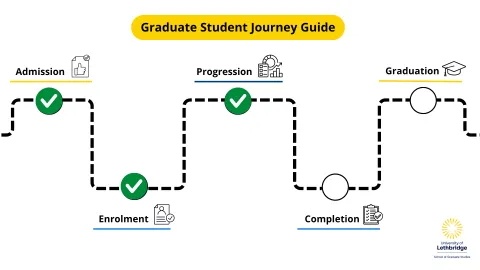
Progression
The Progression stage includes the academic, research, and administrative requirements that support your continued advancement toward degree completion. Students complete program milestones, submit progress reports, develop and obtain approval for research proposals, maintain academic standing, manage registration and program changes, and participate in opportunities such as co-operative education or coursework at other institutions where applicable.
Academic Progress and Program Milestones
All graduate students are required to meet with their Advisors/Supervisory Committees to review their progress and academic performance at least twice per academic year (approximately every six months), and in some academic units once per academic term (see the School of Graduate Studies Policies and Procedures).
- Master of Nursing (Thesis route) students: You are are required to meet with the Supervisory Committee at least once per academic term (Fall, Spring, and Summer).
- Master of Education and Master of Counselling students: You are required to submit Progress and Standing Reports if completing the Project or Thesis
- Master of Education (Counselling Psychology) and Master of Counselling students: You are required to submit an annual progress report specific to your profession
You and your Supervisory Committee conduct a review meeting to discuss and assess your program, work completed and the plan for the upcoming term. You are encouraged to discuss professional development opportunities during these meetings as well.
Submission of this report is a two-part process:
- You submit the Statement of Progress (Student) form which includes details about milestones completed as part of your program and a work plan for the upcoming term. Use this form to request a program extension.
- Your supervisor (or one of your co-supervisors) submits the Statement of Progress and Standing (Supervisor) form which includes a recommendation of your standing in the program with rationale from your Supervisory Committee. Any changes to your planned courses should be reported here.
Culminating Activities - Thesis, Project, Capstone
Consult with the Office of Graduate Studies and Research in Education to determine which culminating activity is the best fit for you
The Capstone is conducted in a supportive seminar environment that draws on the participant’s experience in the graduate program in order to synthesize the student’s learning in the creation of a significant contribution to scholarship and/or professional practice.
A Project is generally intended as an application to an existing methodology or procedure. Often, students will use the project as a demonstration or as an implementation of something that does not currently exist in their system. Thus, it is more practice oriented, even though it must have solid grounding in the literature. Students engage in a systematic inquiry of a topic relevant to their profession. This inquiry is grounded in theory and research but typically focuses on practice. Methods of inquiry may be both qualitative or quantitative.
A Thesis is theory-oriented, and begins with the posing of a question that will in some way contribute to the building or validating of theory. Considerable depth is expected in the review of literature, the application of a disciplined and clearly described methodology for dealing with the research questions, a thorough description of the results of the work (both descriptive and connotational), a synthesis of the research finding with extant literature, and implication of the research for both theory and practice.
Carefully review the forms, guidelines and reference information regarding your culminating activity. It is critical that students orient themselves to the process.
Refer to the School of Graduate Studies Policies and Procedures and the Graduate Studies Calendar and Course Catalogue for detailed information.
Comprehensive Examination Request
All students in the Doctor of Philosophy program must take and pass a comprehensive examination and the exam is due by the end of your second year in the PhD program.
Submit your request at least four (4) weeks prior to the scheduled date of the comprehensive examination, unless specified otherwise in approved program area Comprehensive Examination guidelines.
Questions? Review the School of Graduate Studies Policies and Procedures and the approved program area Comprehensive Examination guidelines.
Submit your Thesis or Project Proposal
Students in the following programs are required to submit a Thesis or Project Proposal:
- Master of Arts - Note: Master of Arts students are required also to submit an initial Thesis Proposal and a full Thesis Proposal
- Master of Counselling
- Master of Education
- Master of Fine Arts
- Master of Music
- Master of Nursing (Thesis and Project routes)
- Master of Science
- Master of Science (Management)
- Doctor of Philosophy - Note: For this program, the supervisor submits the Thesis Proposal form
- Doctor of Philosophy (Education) - Note: For this program, the supervisor submits the Thesis Proposal form
The deadline to submit your Thesis or Project Proposal is available in the School of Graduate Studies Policies and Procedures
School of Graduate Studies Policies and Procedures
Applies to students in the Master of Arts, Master of Education (Thesis route), Master of Science (Management) and Doctor of Philosophy programs. See the School of Graduate Studies Policies and Procedures for details.
The Thesis Proposal Defence is completed prior to submission of the Thesis Proposal. Following the defence appropriate suggestions, changes and/or additions to the proposal are addressed by the student before the Thesis Proposal is submitted.
Program Administration
Change of Supervisory Committee Form
Students in the following programs have a Supervisory Committee:
- Master of Arts
- Master of Counselling and Master of Education (Project routes)
- Master of Education (Thesis route)
- Master of Fine Arts
- Master of Music
- Master of Nursing (Thesis route)
- Master of Science
- Master of Science (Management)
- Doctor of Philosophy
See the School of Graduate Studies Policies and Procedures for details about when your committee must be established by and the requirements for membership of your committee.
All members of your Supervisory Committee must also be approved and current members of the School of Graduate Studies. See the School of Graduate Studies Governing Principles for details.https://uleth.service-now.com/sgs?id=sc_cat_item&table=sc_cat_item&sys_id=2eca0b261b767410bcf2631e6e4bcb6d
Applicants who intend to transfer from a ULethbridge master's program to an approved doctoral program must satisfy basic criteria before the University will consider approving the transfer. See the Graduate Studies Calendar and Course Catalogue for detailed information.
Registration and Academic Status
Continuous registration in the Winter, Summer and Fall terms of each year of your program is required for part-time and full-time graduate students.
Students can log onto the Bridge to withdraw from one or more courses in a given term/session.
If you wish to withdraw from any of your courses or program (thesis), contact the School of Graduate Studies prior to withdrawing. Graduate students are required, by policy, to maintain continuous registration in their programs (3 terms per year). Graduate students should review the Leave of Absence policy published in the Graduate Studies Calendar.
MA, MFA, MMus, MSc, and Ph.D.: Contact your Supervisor in the event that you need to withdraw from one or more of your courses following the add/drop deadline.
MC, MEd, MHSMgt, MMgt, MN, MSc Health Sciences (all majors), MSc (Mgt), Graduate Diploma (AMHP), and Graduate Certificate (HSMgt, ACSA) programs: Contact the relevant Faculty office in the event that you need to withdraw from one or more of your courses following the add/drop deadline.
The deadlines for withdrawals are found in the ULethbridge Graduate Studies Calendar and Course Catalogue.
If you want to take a course in a different field, but you are worried that you might not do as well as you would like, you can designate the course as Credit/Non-Credit.
When you designate a course as Credit/Non-Credit, you essentially have insured your GPA because you will not receive a letter grade in the course unless you receive a “B-” or higher at the master’s level or a “B” or higher at the doctoral level. If you get less than a “B-“ at the master’s level or a “B” at the doctoral level, you have failed the course, and an “NC“(No Credit) will appear on your transcript. This indicates that you did not receive credit for the course, but an “NC“ will not bring down your GPA.
Students must designate a course "Non-Credit" on or before the deadline listed in the Dates and Deadlines (Academic Schedule); this destination cannot be done retroactively.
Open Studies students are not eligible to use Credit/Non-Credit designation. See the Registration Dates and Deadlines for the date on which you may designate courses as Credit/Non-Credit for the current Fall or Winter term or Summer session. Also, see the Regulations, Policies, and Program Requirements section in the Graduate Studies Calendar and Course Catalogue for more information and limitations associated with Credit/Non-Credit.
Equivalent courses can be substituted (one for the other) to meet the same course requirement.
For example, prior to the 2016/2017 calendar year, Art History 5150 was known as Art History/Museum Studies 5150. These two courses are equivalent; so, if you took Art History/Museum Studies 5150 prior to 2016 and now take Art History 5150, you will be repeating a course.
The regulations that apply to repeated courses also apply to equivalent courses. Courses that are equivalent to other courses are denoted with an ‘Equivalent' course element in the course description. The Graduate and Undergraduate Course Catalogues can be accessed here.
At ULethbridge, a graduate student may repeat a course previously taken one (1) time. A grade may be improved by completing either the course or its equivalent.
Three important things to note are:
• Students wanting to improve their grade in an Independent Study, Series or Topics course must repeat the section with the identical title.
• Courses that are equivalent are denoted with an ‘Equivalent’ course element in the course description and include courses that have been renamed or renumbered, and Topics or Series courses that have been regularized.
• Under certain circumstances, the degree-specific program committee may recommend another course to the School of Graduate Studies Dean or Designate for approval consideration.
If a student repeats a course, the grades for each attempt are recorded on the transcript, but only the grade and credit hours for the most recent attempt are computed in the grade point average (GPA). Students may not have grades and credit hours for more than one attempt calculated in the GPA. Students who have repeated a course must submit a Repeated Course form. A student may not use a Credit/Non-Credit designation to replace a previously earned grade. Contact the School of Graduate Studies for more information.
If you are a master's student, receiving a grade lower than a "B-" means that you have effectively failed the course. If you receive a grade less than a "B-", your official transcript will show a non-credit designation as this course will not count towards the completion of your degree requirements.
A student who receives two grades below a ‘B-’ may be required to withdraw from the program. Furthermore, a student must obtain a minimum cumulative program GPA of 3.00 in order to graduate from the program.
If you are in a doctoral program, receiving a grade lower than a "B" means that you have effectively failed the course. Doctoral students with unsatisfactory academic performance in the program may be put on probationary status or required to withdraw from the program entirely!
Doctoral students are also required to maintain a minimum cumulative GPA of 3.00 for all letter-graded courses completed and included in GPA calculations to graduate.
If you have questions about retaking a course that you received below the minimum grade in, please contact your Graduate Program Office.
If you have extenuating circumstances (e.g. illness or a family emergency) that interrupt or prevent your ability to continue your studies, you can submit a request for a Leave of Absence.
Students can formally request a Leave of Absence by submitting the Leave of Absence Request form in the SGS Portal.
When submitting the Leave of Absence Request, you will need to provide the Start Term, End Term, Rationale, and any relevant supporting documents attached to your request form.
Typically, a Leave of Absence can be up to 12 months long. During this time:
- You are not required to register in your program.
- You are not assessed for any fees.
- You must request a deferral for any awards, scholarships, or bursaries that you are set to receive.
- The time granted for the Leave of Absence is not counted toward the residence requirement.
- You will not have access to University of Lethbridge resources and services (e.g., Library privileges) as a student.
- You do not have to be actively engaged in coursework or the research requirements of their degree program.
When you are returning from an approved Leave of Absence, contact your Graduate Program Office and let them know that you have completed your leave. You will then have to register for your courses prior to the Add/Drop deadline.
Program Status Changes
MA, MFA, MMus, MSc, and PhD programs:
If you need to extend your program beyond the maximum time limit for program completion, the Dean of the School of Graduate Studies may approve an extension to your time limit for up to 12 months. To request a program extension, you must submit a completed Statement of Progress and Standing (Student) form in the SGS Portal with an attached rationale for the request, including a detailed timeline for program completion.
MC, MEd, MHSMgt, MMgt, MN, MSc Health Sciences (all majors), MSc (Mgt), Graduate Diploma (AMHP), and Graduate Certificate (HSMgt, ACSA) programs:
If you need to extend your program beyond the maximum time limit for program completion, contact the relevant Graduate Program Office for advice on how to proceed with your extension request and registration.
Readmission after Withdrawal:
Students who withdraw or who are required to withdraw must successfully apply for readmission by the appropriate deadline.
Graduate Studies Calendar and Course Catalogue
Graduate students wishing to withdraw from their graduate program at the end of a term may do so by refraining from registering for the subsequent term. Please notify the appropriate Graduate Program Office via email of your decision to withdraw.
Students who withdraw or who are required to withdraw must successfully apply for readmission by the appropriate deadline.
Experiential and External Learning Opportunities
The Co-operative Education/Internship Option is available to students for the MA, MSc, MSc (Health Sciences), and MSc Mgt programs. Co-operative education integrates academic study at the master’s level with relevant, paid work experience in appropriate fields such as government, institutions, and industry. During a co-operative education, the University, the employer, and the student are in partnership to ensure an enriching experience for the student's professional development.
Graduate students can apply for a Co-op option in the first term of their graduate program; therefore, students are encouraged to contact the Career Bridge Office as soon as possible.
Normally, students are required to complete two work terms of four months each to earn the co-op designation for their degree.
Once you are accepted into a co-op placement, the Co-op Student Handbook has valuable information on milestones during your placement and returning to your studies after your work terms are complete.
Students must be registered for the entire duration of their work terms, and are not permitted to withdraw from the work placement without penalty of failure.
This is treated as a non-credit course recorded on your transcript and does not affect your degree requirements. Refer to the applicable degree sections in the Graduate Studies Calendar and Course Catalogue for more information.
Additional Resources for Graduate Students
Any research project with human or animal participants requires ethics review and approval. The approval or waiver must be obtained prior to the recruitment and data collection phases of the study.