
2024 Top 10 Finalists
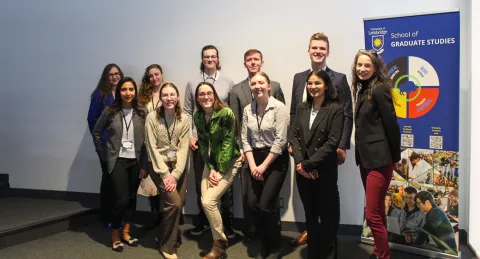
For the first time since 2020, the Three Minute Thesis (3MT) finals were hosted in person, in collaboration with the Graduate Students’ Association’s (GSA) Meeting of the Minds conference on March 23, 2023.
The first-place winner, Jenna Letain, represented ULethbridge at the Western Regional 3MT finals hosted at UBC Okanagan.
The Buzz About Honey Bee Viruses (1st Place)
Participant: Jenna Letain, Supervisor: Dr. Trushar Patel
Over the past couple of decades, honey bees have been facing a significant population loss. There are many reasons that contribute to this, but one that has seen more urgency is viruses. Viruses can hijack their host’s machinery, or proteins, and use them to their advantage. My thesis work aims to find out which specific machinery are being hijacked by honey bee viruses, and what relevance this has to the host’s immunity. There are currently no treatments for honey bee viruses on the market, so researching how these viruses operate is important for developing therapeutics.
The Ecological Football: Making a Conversation Touchdown! (2nd Place)
Participant: Emma Neigel, Supervisor: Dr. Jenny McCune
How can we determine the relative influence of factors limiting a species' distribution? And how does ecology relate to a game of football? Let me explain how my research on the wood poppy can be used to inform conservation with an experimental seed addition. You probably never considered the journey a seed takes to get into the end zone of establishment to a seedling. Wood poppy seeds play in a game of ant vs. mouse with 3 main components: (1) abiotic factors, 2) biotic factors, and (3) dispersal.
Enhancing Executive Functions Through Play (3rd Place)
Participant: Jade Oldfield, Supervisor: Dr. Robbin Gibb
My research focuses on improving adolescent executive functions (EF) through play. The research program in question is testing a curriculum of games, table top and physical games, developed for teenagers. The goal behind the games builds on the Building Brains Together program for children, by using game play to strengthen EF skills. The program is tested through surveys, psychometric tests and lego motor tasks.
Colonial Shadows: Addressing Mental Health Disparities Among Asian Immigrants (People's Choice)
Participant: Supriya Middha, Supervisor: Toupey Luft
In my research, I explore the impact of colonial legacies on mental health care for Asian immigrants, highlighting how Eurocentric approaches, cultural appropriation, and historical traumas shape their experiences. My research employs postcolonial theory and narrative inquiry to unveil the disparities in current mental health practices. I advocate for a shift towards culturally sensitive care that considers traditional values and healing practices, addressing the consequences of misdiagnosis, service underutilization, and alienation. This study not only challenges existing paradigms but also proposes an inclusive framework for mental health care, emphasizing the importance of acknowledging and integrating diverse cultural perspectives.
Unraveling sex differences in spatial abilities: A pathway towards fostering STEM learning
Participant: Daniela Aguilar, Supervisor: Dr. Claudia Gonzalez
Spatial abilities (SA) allow us to locate objects in the environment and safely navigate the world around us. SA have also shown to be a predictor of Science, Technology, Engineering and Mathematics (STEM) success. Interestingly, males outperform females in most SA tasks. However, most research has used visual spatial information. My research investigated sex differences in SA using visual, auditory, and haptic (sense of touch and limb location) information. By investigating how females and males process spatial information through all their senses, we can better develop training tools and educational programs to improve SA and to foster STEM learning.
Chronic gut inflammation changes threat coping behaviour in females
Participant: Julia Medlicott, Supervisor: Dr. Aaron Gruber
My research investigates how chronic gut inflammation changes threat coping behaviour in female mice through a dextran sodium sulfate (DSS) model of inflammatory bowel disease (IBD). Individuals with these diseases are 2-4X more likely to develop anxiety and depression than healthy populations, it is even more common in females with IBD. New research is uncovering the central role that mitochondria play in depression and anxiety, and the unique way estrogen communicates to mitochondria may contribute to elevated rates in females. This line of rodent studies will direct future human research to find more effective treatments for depression and anxiety.
Population Models for Rare Plants
Participant: Amy Wiedenfeld, Supervisor: Dr. Jenny McCune
Population models can help understand how populations of rare plant species are doing--whether the populations are increasing or decreasing. I'm trying to understand the population dynamics of some populations of four rare plants in southern Ontario, and whether the environment is influencing those population changes.
Slot Machine Reward Schedules: What Makes them so Enticing?
Participant: Jonathan Le May, Supervisor: Dr. David Euston
It's estimated that Canadians spend ~$20 billion dollars gambling each year, but why would you play a game when you know the odds are stacked against you? My research uses a novel schedule preference task to demonstrate the main allure of gambling reward schedules is actually based on the delay to receiving rewards, rather than randomness or uncertainty. This has widespread implications not only for gambling regulation, but also for how we interpret the value of everyday activities in our own lives.
How does chronic sickness affect decision making?
Participant: Ben Livingstone, Supervisor: Aaron Gruber
My research investigates how chronic diseases change the brain. This work focuses on ulcerative colitis, a disease of the large intestine which causes pain and other symptoms. Patients with ulcerative colitis experience clinical anxiety and depression at much higher rates than the general population. I want to figure out why anxiety and depression are so prevalent in this disease by determining how it changes the brain. I use a rat model of ulcerative colitis that is induced by a chemical called dextran sulphate sodium, or DSS. In combination with DSS I use a binary choice task to measure behavioral differences.
Effects of Circadian Rhythm Disruption on Hippocampal Activation
Participant: Robert McDonald, Supervisor: Robert McDonald
Shifts in light exposure like those caused by changing time zones are known to cause circadian rhythm disruption. I am investigating what effect circadian rhythm disruption has on the hippocampus, which is a brain region heavily involved in spatial memory. To do this, I am using 2-photon imaging to observe the firing patterns of hippocampal neurons in mice while they are forming new spatial memories.