
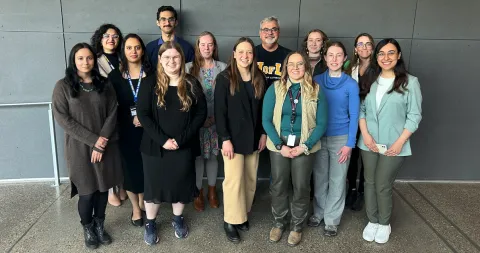
2025 Top 10 Finalists
Three Minute Thesis (3MT) 2025 was held on March 13, 2026 at the University of Lethbridge. The top 10 finalists competed for the first, second, third, and people's choice award categories.
The first place award winner, Natalie Krizan, represented the University of Lethbridge at the Western Regionals at the University of Victoria on May 6, 2025.
Laser Beamin' the Burns: How the Past Informs the Future of Forest Fire (1st Place)
Participant: Natalie Krizan, Supervisors: Laura Chasmer (ULeth) and Raphaël Chavardès (NRCan)
Fire is a necessary process that once rejuvenated forests in Jasper National Park. For over a century, though, it was controlled intensely. Without fire, the forests have grown very old and dense. As a result, fires now are larger and more intense than they once were. I am using a laser-based 3D modelling technology called lidar to create a detailed map of a recent burn in Jasper. Once I know how it burned, I can figure out what caused that pattern. Understanding this allows us to predict how areas with similar forest conditions will burn in the future.
Population Models for Rare Plants (2nd Place)
Participant: Amy Wiedenfeld, Supervisors: Dr. Jenny McCune
Census-type data can be collected for rare plants to monitor how populations are changing over time. This information can be used to improve conservation efforts. I am studying four rare plants in the Carolinian forest in southern Ontario. I have made a population model for one of my study species, and have found that most of the Ontario populations are stable or increasing. This census data can be used to improve conservation for these rare species.
Roadmapping Development of Gambling Addictions (3rd Place)
Participant: Tara Laverty, Supervisors: Dr. Euston & Dr. McDonald
Childhood adversity is a known risk factor for developing mental health and addiction disorders, including gambling. Yet, so little is known about exactly how a gambling addiction develops. My research connects multiple leading theories to attempt to longitudinally study gambling behaviors in rodents. I'll be using an early life stress model to compare how stress impacts gambling and impulsivity behaviors and analyzing neurobiology - aiming to create an animal model that can be used for further study on addiction development and treatment.
4D Classification of Naturalistic fMRI Data Using Deep Learning Methods and Integrating Explainability Approaches (People's Choice)
Participant: Sara Asadi, Supervisors: Dr. Chelsea Ekstrand and Dr. Hardeep Ryait
My research introduces a 4D classification approach for fMRI data using deep learning. The method combines 3D convolutional neural networks (CNNs) to capture spatial features and Long Short-Term Memory (LSTM) networks to model temporal patterns. Using movie-watching fMRI data as naturalistic paradigm, the study focuses on predicting Beck’s Depression Inventory (BDI) scores. By preserving both spatial and temporal information, this approach aims to improve classification accuracy compared to traditional methods. Interpretability techniques such as DeepExplain and Grad-CAM provide insights into relevant neural regions. The findings contribute to neuroimaging research by improving classification accuracy and demonstrating the advantages of 4D modeling for understanding brain function in naturalistic paradigms.
How Do Brains Remember Real Life and Movies Differently?
Participant: Alireza Taheritorbati, Supervisor: Chelsea Ekstrand
In this research, I am focusing on the strength of the theta-gamma phase-amplitude coupling (PAC) in the real-world context compared to the 2D video-watching context. Participants are divided into two age groups (younger adults 18-35 and older adults 55-75 years old) and two experimental conditions (real-world and 2D video watching). I expect to see higher theta-gamma PAC in real-world conditions and among younger adults than older adults. Memory recall is also expected to be better in real-world conditions and among younger adults.
Stuck in a Box: How Context Impacts Learning
Participant: Amanda Huber, Supervisor: Robert McDonald
It turns out that the context we are in, our "box", can actually have a large impact on how we learn. In rodent studies, trying to learn the opposite of the original task while in the same context as the initial training can result in deficits in learning, which are not seen if the reversal takes place in a different context. Why and how context can impair our learning is what I am exploring in my thesis.
$elling Green
Participant: Emma Neigel, Supervisors: Dr. Jenny McCune
Have you ever thought about what makes the perfect home? Its’ probably something to do with the community. Join me as I explore the 3W’s of the great green communities – our forests- to learn about what makes the perfect home for the rare plants that live there. I research: (1) Where do they live? (2) Who do they live with? and (3) Why? To build the perfect new homes for rare and endangered plants we need to answer the 3W’s. I do so by conducting plant community surveys and identifying the other plants, or ‘neighbours’, that live in their communities.
Real World Memory Networks: Studying Episodic Memory and Sex Differences Using Naturalistic Stimuli and fMRI
Participant: Jane O'Connor, Supervisor: Dr. Chelsea Ekstrand
Naturalistic stimuli like movie watching are being used in fMRI research to understand how we process narratives that relate to the real world. Episodic memory and the recalling of narratives employs many regions in the brain and requires a multimodal study approach. By using stimuli that captures more of the real world and combining it with a functional connectivity neuroimaging approach we open up the doors to mapping episodic memory in a more relevant and applicable way.
Is brain synchrony the language of love?
Participant: Niayesh Allahdad, Supervisors: Dr. Chelsea Ekstrand
My name is Niayesh Allahdad, and I am a Master's Student at the Department of Neuroscience at the University of Lethbridge. My Research focuses on understanding the role of relationship satisfaction in neural synchrony in young romantic couples. I aim to determine whether neural synchrony stems solely from the shared experiences two people have or if it's caused by something deeper, like the bond of love.
Movement Pattern Analysis of cattle Lameness: Integrating Detection and Innovation
Participant: Sandeep Kaur, Supervisor: Dr. Robert Sutherland
Canada’s beef industry, especially in regions like Lethbridge, faces a significant challenge: lameness in cattle. Traditional detection methods rely on subjective judgment, leading to inconsistencies. My research tackles this issue by developing a mobile app that uses movement patterns—stride length, weight balance, and posture changes—to provide accurate, real-time lameness detection. This affordable tool empowers farmers to take quick action, improving animal welfare, farm productivity, and industry sustainability. By bridging science and farming, this innovation strengthens local economies and promotes humane livestock care, ensuring a future where healthier cattle lead to a more sustainable beef industry.