
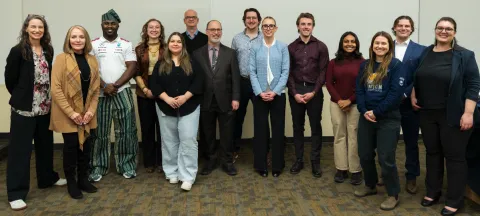
2026 Top 10 Finalists
Three Minute Thesis (3MT) 2026 was held on March 12, 2026 at the University of Lethbridge.
The first place award winner, Christopher Beaton, represented the University of Lethbridge at the Western Regionals at the University of Regina from April 2-5, 2026.
The Rhythm of Decline: Using Ultradian Rhythms to Detect and Stop Alzheimer's (1st Place)
Participant: Christopher Beaton, Supervisor: Dr. Robert Sutherland
In my speech, I discuss how I am currently studying the ultradian rhythms of mice models using new AI tools, and how by studying these rhythms we may be able to detect Alzheimer's earlier than we are currently able to. I also discuss how these rhythms may be the key to finding a cure for Alzheimer's, by helping strengthen our brains and ward off the effects of this disease.
The Godfather of Gambling Addiction: How Dopamine Pulls the Strings (2nd Place)
Participant: Ryan Rosato, Supervisor: David Euston
By highlighting the true gravity of gambling addiction and how fast it is growing, a need for a solution is required. I provide a description of my experiment while also proposing an analogy to cumulatively understand the issue at hand. I go into more detail as to the expected results of my experiment while highlighting how we can resolve these issues and provide a cure to gambling addiction. But most importantly, I aimed to illustrate the powerful and central role that is dopamine and how it not only is responsible for forming these behaviours, but also how it perpetuates them.
How Tiny Changes Guide Protein-Making Decisions (3rd Place)
Participant: Clara Cunha, Supervisor: Dr. Stacey Wetmore
This project investigates how small chemical modifications on transfer RNA (tRNA) influence protein production in cells. These modifications fine-tune how efficiently and accurately tRNAs interact with messenger RNA during translation. Using computer simulations, I examine how the presence or absence of a specific modification changes these molecular interactions at an atomic level. By understanding what this modification actually does, my research helps explain how cells maintain smooth and reliable protein synthesis — and how disruptions in this process can contribute to human disease.
Mari Mari: An Exploration of How Mapudungun is Taught Online
Participant: Daniela McGonigal-Plankey, Supervisor: Conor Snoek
In a world where the loss of human linguistic diversity is rising, the need to preserve Indigenous languages is even more important. My research uses thematic analysis where I create codes and find patterns to answer the question: How is Mapudungun taught online? Through those codes and patterns, the semiotic elements show us aspects of Mapuche culture and uncover the cognitive tools used to create an engaging environment for someone learning Mapudungun online.
The Brain Beyond Pairwise
Participant: Eric Albers, Supervisors: Masami Tatsuno / Matthew Tata
Complex systems are composed of many individual components that interact in various ways. Characterizing these interactions is necessary to understand how these systems work. However, current statistical methods are limited to examining interactions between only two components, called pairwise interactions. The human brain is one of these complex systems and relying on pairwise explanations of interactions within the brain can only provide a limited understanding of how it works. My research uses methods from information geometry to identify higher-order interactions in the brain's default mode network to show that these interactions are crucial and pairwise measures alone are inadequate.
Reconstructing the Sensory Ecology of the Extinct Great Auk (Pinguinus impennis)
Participant: Janani Edussooriyage Dona, Supervisor: Dr. Andrew Iwaniuk
The extinction of the Great Auk in the mid-19th century represents one of the most dramatic and well-documented losses in recorded history. While previous studies have examined aspects of its ecology, much of its behaviour remains uncertain. Comparative anatomy can provide insights into the Great Auk’s sensory abilities because acuity and sensitivity are closely linked to the structure of sensory organs and brain regions that process sensory information. The internal morphology of the avian braincase closely reflects the brain, and because the skull houses both the brain and sensory organs, cranial anatomy offers a valuable proxy for reconstructing sensory capabilities in extinct species. Here, I will use micro-CT scans of intact Great Auk skulls to estimate its visual, olfactory, auditory, and tactile abilities relative to extant alcid species. This quantitative, multisensory approach will provide novel insights into the behaviour, and ecology of the extinct Great Auk.
The Clockwork Casino: Neutral Signatures of Reinforcement Schedules in Slot Machine Play
Participant: Jordyn Musial, Supervisor: Dr. Chelsea Ekstrand and Dr. David Euston
This research tests whether reward uncertainty drives gambling addiction in humans. Using fMRI, eighty adults will play a slot machine under unpredictable (random ratio) and predictable (fixed ratio) reward conditions while their brain activity is measured. By examining BOLD signals in reward networks, this study investigates how uncertain rewards influence motivation and persistence at the neural level. Findings could provide concrete human evidence to guide prevention and treatment strategies for the 300,000 Canadians affected by problem gambling, moving beyond animal models to understand the mechanisms underlying addictive gambling behavior.
A Bad Haircut at the Burnin' Barbershop
Participant: Natalie Krizan, Supervisors: Laura Chasmer, Raphaël Chavardès, and Hester Jiskoot
Did you know that forests need haircuts? Of course, instead of scissors and razors, it is fire that gives forests a trim. But what happens when fire is eliminated from the landscape for a century? Forests become unmanaged and unhealthy with dense tree stands and lots of knots and tangles. When a fire occurs under these conditions, the ‘haircut’ is more of a buzzcut rather than a nice, neat trim. My research involves using a 3D modeling technology to take a detailed look at one forest’s really bad haircut, as a result of a century without fire.
Designing Smarter RNA Drugs with Computers
Participant: Ridwan Tajudeen, Supervisor: Stacey Wetmore
RNA interference (RNAi) is a natural gene-silencing mechanism in which small interfering RNA (siRNA) suppresses gene expression, making it a powerful therapeutic strategy. siRNA-based drugs have been developed to treat diseases such as genetic disorders, but their clinical use is limited by instability and off-target effects. Chemical modifications have addressed these challenges, enabling the FDA approval of six siRNA drugs. However, structural understanding of how these modifications influence siRNA behavior remains limited. My study uses molecular dynamics simulations to analyze the structural preferences of FDA-approved siRNA drugs and assess how modification patterns affect their structure, providing insights to guide the rational design of better siRNA therapeutics.
Unfolding Alzheimer's Disease: One Brick at a Time
Participant: Ryley Chalack , Supervisor: Vineet Rathod
Alzheimer’s disease can be understood like improperly built Lego structures. Proteins normally fold for specific brain functions, important for processes associated with memory and learning. Although essential, proteins can undergo a structural transition due to incorrect instructions being followed in the building process, leading to the formation of toxic aggregates that damage neurons and impair memory. My research focuses on engineering a toolkit of amyloid proteins that mimic these faulty assemblies to identify the “wrong pieces” responsible for toxicity and disease progression. By analyzing their structure and interactions, this work aims to reveal mechanisms behind Alzheimer’s and guide new treatments to prevent disease onset, benefiting the approximately 700,000 Canadians affected today by Alzheimer's disease.