
Professional Development Framework & Resources
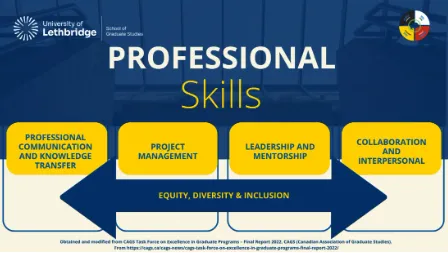
The School of Graduate Studies' approach to professional development is guided by a professional skills framework developed by the Canadian Association for Graduate Studies (CAGS), which supports a common national approach to the development and recognition of professional skills among graduate students.
The image above is the broad categories of skills that are sought by employers in the workforce, in the accordion below are the overlapping skills utilized by any and all industries as well as the learning outcomes that describe success.
- Employs complex communication skills in a manner that contributes to organizational, provincial, and national productivity.
- Effectively communicates research to a diverse audience in written, spoken, visual, and other forms.
- Demonstrates effective writing, publication, and public speaking skills
- The capacity to create and articulate a shared vision while motivating support for the vision and empowering others to achieve excellence
- Demonstrate the ability to think critically and problem solve, innovate, and effectively manage change, respond well and adapt to changing environments.
- Demonstrate a capacity to guide motivate and influence others to contribute to organizational, provincial or federal goals
- Demonstrate an awareness of leadership in team settings and the ability to collaboratively work towards the achievement of mutual team goals.
- The ability to problem-solve, innovate, respond well and adapt to changing environments and influence others to adapt to changing environments.
- The capacity to collaboratively produce and share knowledge and innovation.
- The ability to strategically work towards common goals and visions that impact organizational, provincial or national efficacy.
- Demonstrate the capacity to acknowledge and respect diversity.
- Ability to develop, manage, and maintain effective partnerships and relationships among colleagues and other stakeholders.
- Capacity to apply effective interpersonal skills such as active listening, diplomacy, and negotiating in appropriate contexts.
- The capacity to create and undertake diverse projects and effectively manage and monitor projects and/or programs including people.
- Demonstrate the ability to utilize frameworks that aid the understanding of cultural, racial, gender, ability, sexual orientation, and other differences and similarities.
- Ability to distinguish one's own cultural, racial, gender, ability, sexual orientation and other differences and similarities, influences and an awareness of one's own ways of making meaning, and of one's judgements, emotions, and physical sensations, and the capacity to bridge these differences in research design and varying organizational contexts (bridging).
- Demonstrate the ability to explain complex and/or ambiguous concepts relative to specialized content or skill areas in organizational contexts.
- Ability to adjust instructional content, methods and mentoring activities to match varying learning styles, abilities and diverse backgrounds.
- Capacity to apply sound pedagogical principles including assessment, design, delivery, implementation, and evaluation to various organizational contexts.
Partners with Virtual Resources
Mitacs
Mitacs is excited to provide professional development courses that respond to modern learning preferences, and better align our content with the competencies needed by industry partners and employers. Each course is designed to improve upon one or more core competencies and is facilitated by industry leaders.
Udemy
All the skills you need in one place. From critical skills to technical topics, Udemy supports your professional development.
Canadian Centre for Diversity and Inclusion
CCDI's webinars provide invaluable insight into the latest thinking about diversity, equity and inclusion in Canada. Content is appropriate for a wide variety of professionals.