
2023 Competition Gallery
From Petri Dish to Populations of Fish (1st Place)
Participant: Chloe Devoy
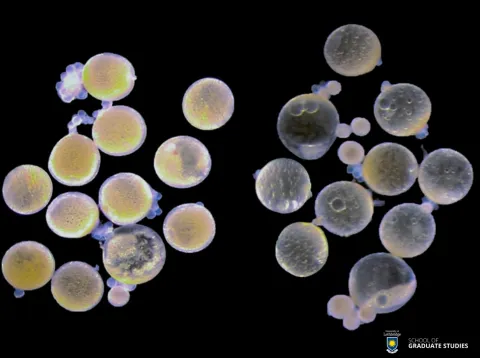
Pictured on the left are oocytes – undeveloped fish eggs. On the right are fully developed eggs that I induced to mature outside the fish body using a novel protocol that I designed. This protocol allows us to efficiently screen the reproductive toxicities of new chemical products being brought to market. This is important as manufactured chemicals often end up in aquatic environments where they can induce adverse effects on fish species that largely contribute to our diet and global economy.
Using this protocol, I examined the effects of a novel chemical flame retardant commonly added to electronics that’s usage is set to increase soon. My research demonstrated that this flame retardant impairs fish oocyte development resulting in adverse reproductive effects. Impaired fish oocyte development can ultimately lead to fish population decline. Therefore, this protocol could be used to predict population-level effects from a petri dish.
A timeless companion: Mycorrihizal fungi in agricultural crops (2nd Place)
Participant: Melissa Telfer
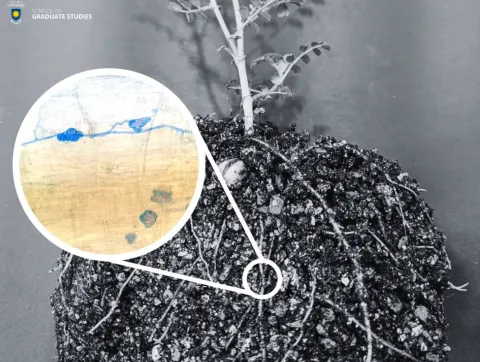
This 400-million-year-old obligate symbiotic relationship is made with over 75% of land plants. Arbuscular mycorrhizal fungi (AMF) absorb nutrients, like nitrogen and phosphorus, from the far reaches of the soil and transport them to the roots in exchange for photosynthetic sugar. AMF can be stained and viewed under a microscope (inset; blue), as seen here in the nitrogen fixing nodule of a legume plant, like this chickpea.
We see both AMF hyphae, and associated vesicles (circular structures) where the fungi stores fat and sugar. Other structures not seen include the arbuscule and spores. AMF are ubiquitous in soils but can be lacking in managed agricultural land. Re-establishing this important symbiosis in crops can provide increased nutrient acquisition, resilience against pests and diseases, and improved soil structure and function. This has the potential to reduce the application of harmful chemicals for the production of increased yields and healthier food.
All Creatures Large and Small (3rd Place)
Participant: Abbe Pawluk
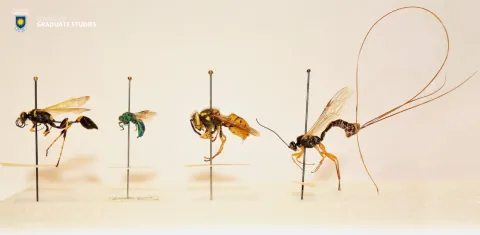
(Left to right: Sceliphron caementarium, Chrysis caeruliventris, Vespula atropilosa, Megaryhssa aurantia.)
Wasps are one of the most misunderstood branches of insects. These small creatures are often overlooked and villainized by the general public, typically only being associated with the "stinging yellowjacket" archetype. In reality, wasps are a highly diverse and unique group of insects, varying in size, sociality, and lifecycles--and few of them actually sting! Some may be colourful and metallic, or dark and svelte; less than one millimetre in size, or over 6 centimetres. Even the daunting S. caementarium or M. aurantia are harmless to humans and, in fact, beneficial natural enemies.
My research explores ways to preserve and promote our native Albertan wasps species, particularly in agricultural settings where they possess high-value as an effective form of pest suppression.
Braiding Our Stories: Adopting Practices of Metissage in English Language Arts (People's Choice)
Participant: Liz Harrison
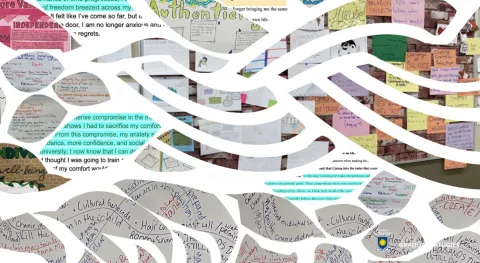
To reflect and capture the experience and practices of Metissage, I created a graphic representation of braiding. White space and shapes create distinction between the narrative strands and methods of storytelling explored. A variety of research is captured here: whole-class 'traveling' conversations, student-created values posters, personal writing, and story-braiding practice. Deep culture and trust have emerged through our practices, and the care of sharing and arranging narrative strands has allowed new understanding of selves and others to emerge.
A Bird in Hand
Participant: Aaron Veale
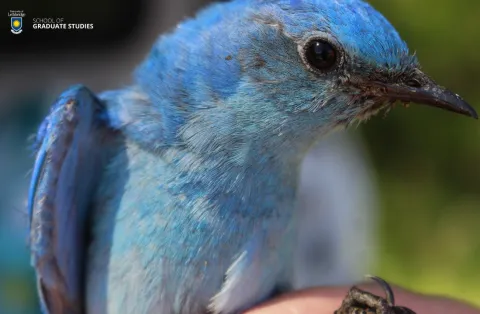
We caught individuals (such as the male pictured) from sites around the province in the nesting season when they were the most territorial. Each bird was checked for injury, banded, and sampled for a small volume of blood before being released back to their nests. We also photographed every for signs of hybridization, like the red vest and deeper blue hue of a Western Bluebird. Amazingly, the beautiful azure blue of bluebird feathers is not from pigment acquired from food, but from microscopic feather structure interacting with light.
Using blood, we can determine variable sites in the bluebirds’ DNA called single nucleotide polymorphisms (SNPs). We will then use the SNPs to search for both ongoing and past hybridization within Alberta’s bluebirds by comparing them to other populations throughout North America. Overall, we hope to gain a better understanding of how hybridization shapes the genetics of Alberta’s Mountain Bluebirds.
Flags for spotted wintergreen population counts
Participant: Amy Wiedenfeld
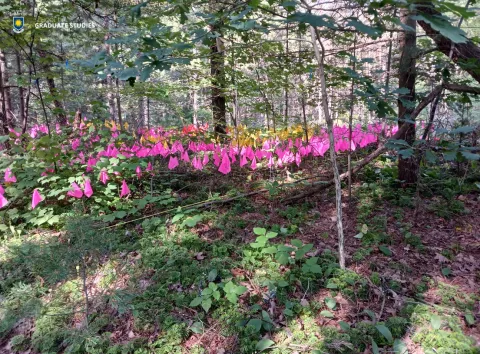
Pink and yellow flags mark out each spotted wintergreen (Chimaphila maculata) plant in a population in a forest fragment in southern Ontario. The spotted wintergreen is a small woodland plant, with dark green leaves that each have a white stripe down the middle. It is rare in Canada, and research on the population viability of the few known populations and what environmental factors drive population change can contribute to conservation of the species. I used these flags to temporarily mark each spotted wintergreen plant while conducting counts of populations like this one. I’m also collecting census data on some of these individual plants and environmental data including canopy cover and soil moisture, to model the population growth rates and what environmental drivers influence this growth rate. Understanding the population trends, especially in relation to the environment, can contribute to conservation efforts for this rare species.
E.T. - Encapsulated in Translocation
Participant: Emma Neigel
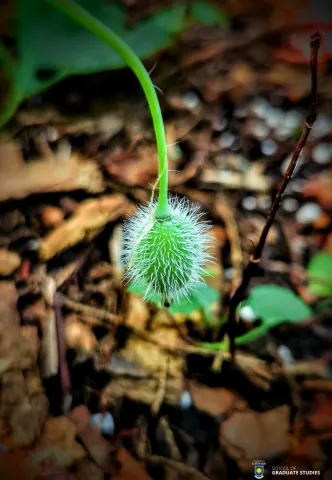
Floating like a UFO in space, the fruit of the endangered wood-poppy (Stylophorum diphyllum) is suspended by a stem, anchored by rhizomatous roots in the rich, deciduous forest soil of southern Ontario. Inside the hairy capsule fruit are tiny seeds- no bigger than coarse salt granules. The encapsulated seeds symbolize individual opportunities for wood-poppy to colonize. Once the capsule breaks open, ants invade the vicinity of the plants and abduct the seeds, harvesting the jelly-like eliasomes attached to the seeds to take back to their mothership, and unintentionally dispersing the seeds along the way. However, wood-poppy’s habitat is now reduced to tiny planets of green and is in dire need of astronomical help bigger than the ants. Humans can help by reintroducing wood-poppies into suitable habitat using conservation translocations. Computer models predict suitability and enable us to test if dispersal or habitat is limiting wood-poppy’s arrival to new, far-away places.
Play's the Way
Participant: Jade Oldfield
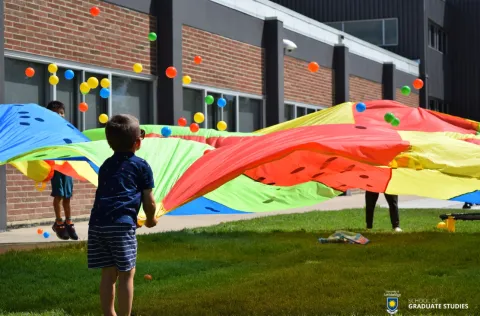
Summer is the busiest time for the Building Brains Together program, created and run by Dr. Robbin Gibb. Over the summer, undergraduate and graduate students have the opportunity of translating research into action by running the play-based curriculum previously researched and tested with pre-school elementary aged children. At the same time, we collect statistics regarding those who participate in the activities, what they think about them, and share information on how to learn more about supporting child development. Moving forward, we will also trial games from the adolescent curriculum and broaden their availability. This image is of an inter-agency outdoor play day during summer 2022, where families could access free outdoor activities, a barbecue and a free game bag to take home for later. This image is the beauty of research applied for public good.
Salamander Sunrise
Participant: Kaegan Finn
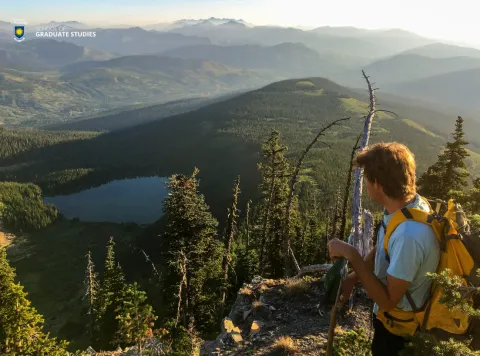
This past summer, my field assistant Dustin Snider and I surveyed over 100 ponds across southwest Alberta for long-toed salamanders as part of my MSc research. Fortunately for us, long-toed salamanders often live in spectacular places. One night after a hard day of surveying, we set up camp on a ridge overlooking the Flathead Range. The following morning as we hiked to the next pond, we were treated to one of the best sunrises either of us had ever seen. Just as the pond came into view and we wondered aloud whether it might hold long-toed salamanders, I snapped this photo of Dustin taking it all in.
Trajectories in the space and brain
Participant: Kushaan Gupta
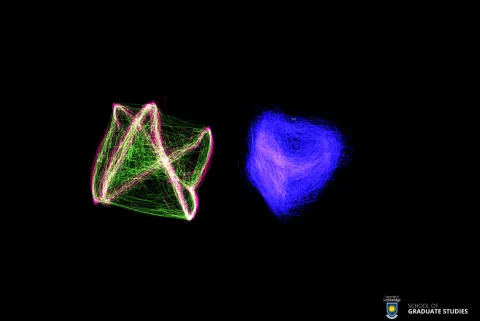
Pictured is the juxtaposition of two different kind of paths followed by a rat navigating in a space. On left, we have the spatial trajectory of animal traversing across a sequence while on the right we have the trajectory of the neural cells in the Prefrontal Cortex (PFC) of the animal. PFC is a brain region known to play a key role in memory and decision-making, and how that ties together has been none less than a mystery. The knowledge of how the changes in behavioural memory-guided navigation relate to the changes of neural trajectory happening in the PFC can pave the way for advancing our understanding of the brain mechanisms underlying the unification of memory and decision-making.
Prairie Fire at Head-Smashed-In Buffalo Jump
Participant: Matthew Sawchuk
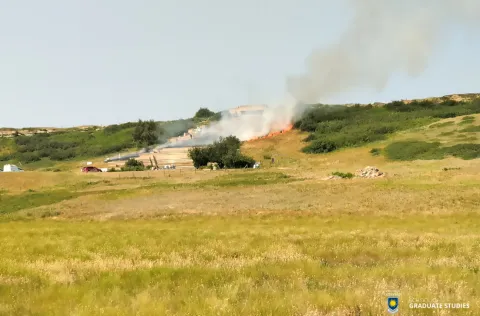
During the summer 2021 Uleth/Royal Alberta Museum Archaeology Field School to Head-Smashed-In Buffalo Jump a grass fire started near the interpretive centre. No one was hurt, the building was undamaged and the archaeological deposits were minimally disturbed. The fire spread along the base of the cliff for a couple hundred meters before it was extinguished by several fire departments and local volunteers. Thankfully it was the least windy day of the project or the fire would have spread far further.
The Impact of Bilingualism on Executive Function in 3-5-Year-Old Children Born Pre-Term
Participant: Sally Sade
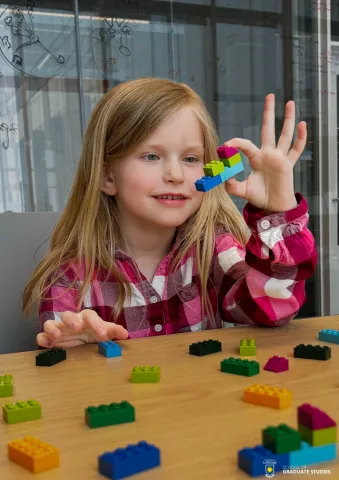
According to the World Health Organization, approximately 15 million babies each year are born pre-term, and the number of these children continues to rise. As these children develop, they have impairments in executive function (EF) which are a set of mental skills that play an important role in dictating future academic success. There is growing evidence that bilingualism could enhance EF skills across the lifespan, although the precise role of bilingualism in EF has been controversial. The objective of this research will be to assess the effects of bilingualism on EF skills in children born pre-term. To do this, I will be using 10 research-based games known to measure and enhance EF. The photo presents a child completing a LEGO building task, one of the ten games. I predict that bilingual children born pre-term will score higher on tasks measuring EF, such as LEGO building, than monolinguals.
Cancer Cell Machinery
Participant: Shannon Healy Knibb
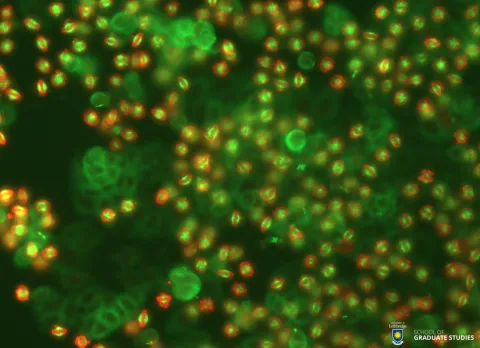
Here we can see the internal machinery that allows cancer cells to divide. Using a microscope and fluorescent tags, we can see the DNA (red) being pulled apart by mechanical proteins (green) so that each cell contains the same genetic material to allow them to divide continuously – the hallmark of a growing tumour. Targeting these mechanical proteins with anti-cancer drugs can stop their division and kill the cancer cells. In my research, I am screening prairie plants for anti-cancer chemicals since many anti-cancer drugs are derived from plants, such as Taxol® which targets these mechanical proteins and is commonly used to treat breast cancer. Identifying new anti-cancer chemicals will provide more treatment options for tumours that are resistant to common anti-cancer drugs. This research will allow us to understand the intricacies of how cancer cells divide and how to highjack their machinery to stop the division from occurring.
Tree Swallow (Tachycineta bicolor); beautiful, acrobatic, aerial insectivore.
Participant: Thilini Thakshila
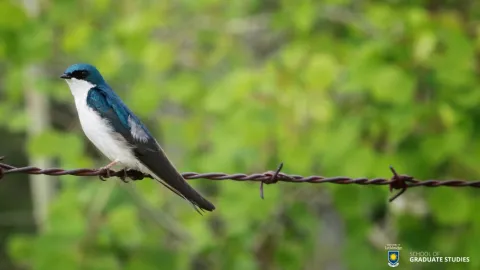
Tree Swallows are a familiar sight in summer fields and wetlands across northern North America. This picture was captured in the Cypress Hills during the last summer field sessions. They are aerial insectivores who feed on flying insects. Tree swallows are one of the best studied birds in North America, yet less is known to us on their population genetics, and migratory patterns. Therefore, we will be collecting blood or feather samples to obtain genetic data and analyze them to understand genetically distinct groups for conservation prioritization. Our preliminary results from triple digest restriction-site associated sequencing indicate potential two population clusters corresponding to eastern and western regions.