
In a world that increasingly relies on dependable shipping options for everything from clothes to car parts to food items, an innovative new business has earned support from a pan-Alberta entrepreneurial program through a two-year, $250,000 Innovation Catalyst Grant (ICG).
Dr. Annie Ray and her start-up company Anandi Botanicals Inc. is at the forefront of supplying tissue cultivated plants for agriculture, horticulture, forestry and conservation. Their specialty is providing virus free plants to greenhouses and nurseries, berry growers, orchards, mining and reclamation companies and more. What makes their products unique is that they will soon be packaged in biodegradable containers that have been embedded with sensors that can track the conditions the plants endure throughout the shipping process.
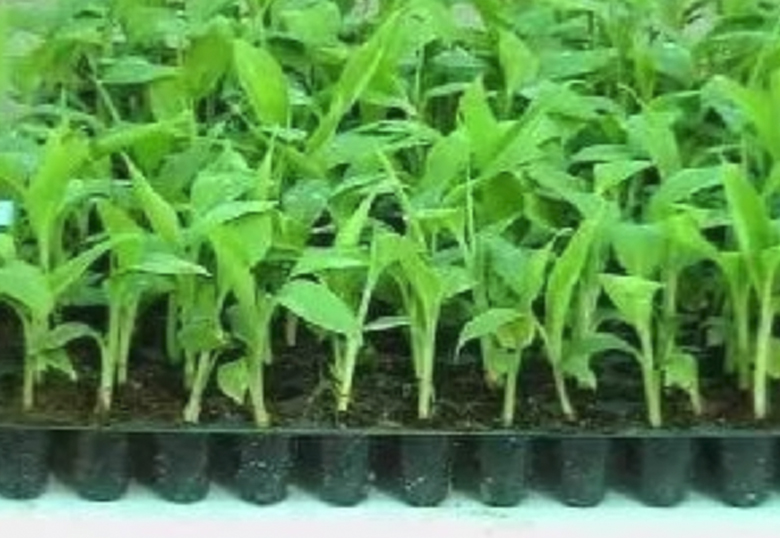
“I have been working in the plant tissue culture industry for more than a decade and observed a gap in shipment tracking for plants. While sensors can be purchased separately to monitor shipment conditions, they are not integrated into a simple system for plant shipping,” says Ray, who has a PhD in plant biology. “I saw an opportunity to fill that gap with a more practical solution, since there was no suitable option available in the market.”
Her idea was to create packaging that integrated the sensors into the containers and, better yet, the containers would be made of a biodegradable material rather than plastic.
“We tried it with plastic packaging first and it worked wonderfully but we wanted something biodegradable, so we started talking with companies that used seaweed as plastics,” she says. “We were doing it on our own, but it was slow without any funding and that’s when I found out about the ICG grant.”
The Innovation Catalyst Grant (ICG) is an entrepreneurial fellowship designed to support recent graduates (master’s or PhD) in science, technology, engineering and mathematics (STEM) disciplines. The program provides a two-year runway for entrepreneurs to develop and commercialize innovative, science-based products and services that contain a hardware component.
“This grant is designed for recent STEM graduates who have really great ideas but because they are just beginning to establish themselves, they don’t have the business relationships or the capital to bring these ideas to market,” says Luc Roberts (BSc ’12, PhD ’23), entrepreneurial strategist for the Teaching Centre and Agility. “What’s great about this grant is that it supports the recipient with not only a salary as well as seed funding, but a network of mentors, peers and innovation ecosystem partners to help them.”
The ICG is administered by partner universities (University of Alberta, University of Calgary and University of Lethbridge) with participation and oversight by the Government of Alberta’s Ministry of Technology and Innovation.
"Alberta is full of brilliant people with ideas worth backing. The Innovation Catalyst Fund exists to make sure those founders can build their companies here, hire here, and keep their intellectual property here,” says Nate Glubish, Minister of Technology and Innovation. “This cohort is proof the model is working. Twelve early-stage ventures, twelve reasons for the next generation of Alberta innovators to bet on this province."
Ray, who is also a recipient of an RDAR-SCAP grant for a conservation project, leases lab facilities at Synbridge. She says that with a successful model shipping plant products using her innovative packaging technique, she is already looking to other industries.
“This is not only restricted to the plant industry, but it could also be used for food and beverage, perishables, as well as pharmaceutical industries. This is only a start,” she says.
A start funded by a unique program that is bringing ideas to life.