
University of Lethbridge researchers are collaborating with the Canadian Space Agency (CSA) to prototype extraterrestrial biomanufacturing (ET-bio), a concept that supports human space exploration and could also benefit Canadians living in remote areas here on Earth.
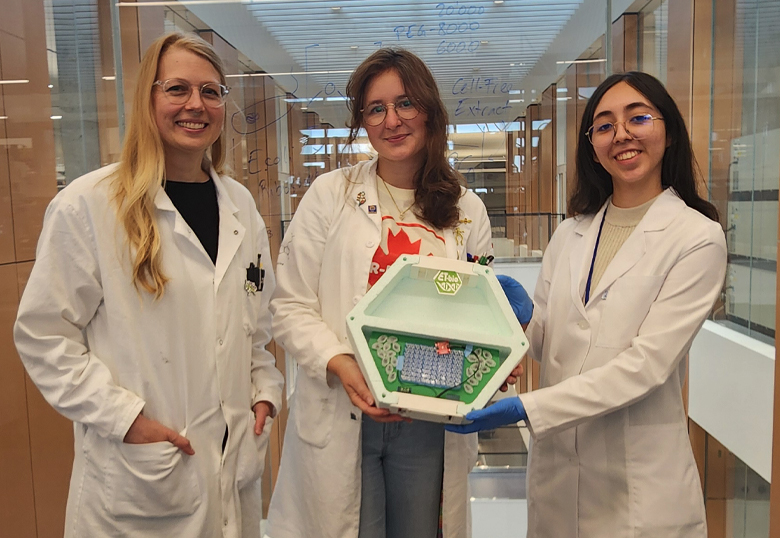
When humans eventually settle on the moon or Mars, what medicines, biomaterials and vitamins will they need? And what if they can make those things on demand? The ULethbridge Willi Lab, led by Dr. Jessica Willi (chemistry and biochemistry), was tasked with supplying biochemical reactions to the CSA for a recent launch that sent payloads into the stratosphere.
“Biochemical reactions can be freeze-dried, sent to space, and then programmed later to make anything encoded on DNA,” says Willi.
On August 19, two identical payloads were launched from a base in Timmins, ON as part of the STRATOS ICARUS 2026 campaign. Included on those payloads were bioreagents prepared by the Willi Lab, including master’s student Roza Gabdullina and MITACS Globalink student Valeria Angulo Villa, who spent the summer assembling, freeze-drying and testing bioreactions for ET-bio.
“The project may sound sci-fi, but it builds real-world skills,” says Willi, who supervised the students. “The young researchers learn hands-on how to operate specialized freeze-dryers, how to work as a team, and how to think scientifically. And of course, all while working towards the launch deadline.”
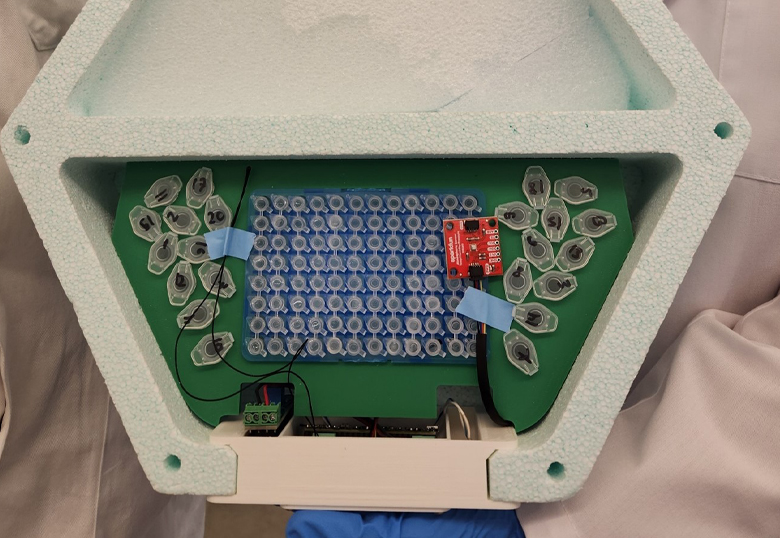
Prototype development of the payload rack to secure the precious ET-bio samples was done at the Agility makerspace. The stratosphere provides a near-space environment ideal for testing and validating new technologies. Once the payloads were recovered in the Northern Ontario wilderness, they were shipped back to Lethbridge for testing. The Willi lab will now determine whether they survived the harsh stratospheric exposure and interpret the telemetric measurements.
“Working on the ET-bio project as a team has given me the opportunity to contribute to testing what conditions are best suited for freeze-drying cell-free systems,” says Gabdullina. “This work is especially valuable to me because lyophilization is also a potential future step in my master’s research, where I hope to move toward a more stable and portable cell-free diagnostic platform.”
For Angulo Villa, her focus for the project was on evaluating and optimizing different protectants to improve reaction stability.
“This work has given me hands-on experience in experimental design, optimization and biological system development, while also strengthening my problem-solving and technical skills.”
While ET-bio is developed for human space exploration, it will also benefit Canadians living in remote and rural areas with limited access to cold chain delivery of medicines.