
Unlocking insight into the manner in which a ribonucleic acid (RNA) known as RMRP factors in cancer biology has led to a national award for University of Lethbridge biochemistry researchers, Drs. Trushar Patel and Higor Sette Pereira, in partnership with Dr. Harpreet Singh from The Ohio State University.
RNA Canada ARN, through its RNA Awards presented by Moderna, recognized the research as Discovery of the Year.
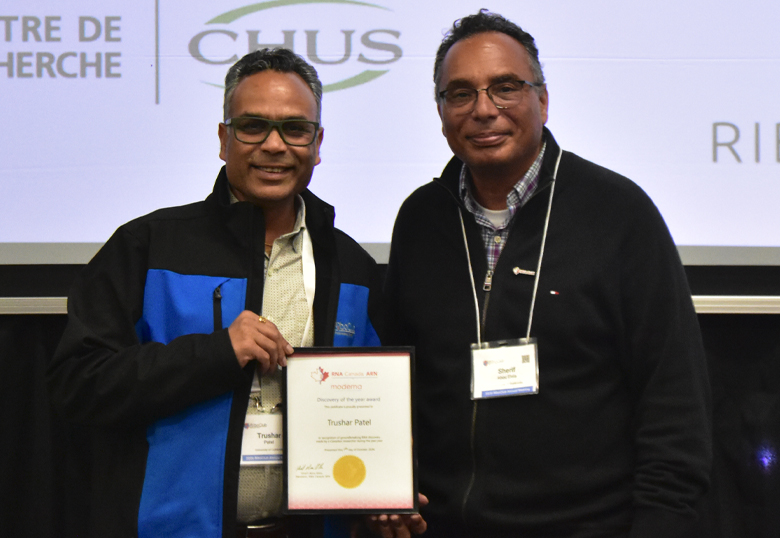
“This seminal work, led by Dr. Patel and his team, sheds light on the mechanism of the non-coding RNA RMRP, revealing a critical role for this RNA in cellular health,” an awards release stated. “By integrating multidisciplinary approaches, they uncovered a role for this disease-associated RNA in maintaining mitochondrial functions opening important directions for understanding disease and developing RNA-targeted therapeutics.”
The study was published in the Proceedings of the National Academy of Sciences in February. Earning a national award for a new discovery further validates the importance of the work taking place in the Patel lab and the sometimes-difficult path foundational research can follow.
“The main take-home message for me and for many of our trainees is that sometimes you know that you are on the right path, and you just have to keep looking at the next set of experiments and figure out what is going to happen next,” says Patel. “There are always minor setbacks you are trying to figure out, but if you believe that there is some potential in what you are doing, then don't give up.”
He says the recognition also shines light on the level of research taking place at ULethbridge, whether it be in the biochemistry labs or in multiple other research clusters throughout the University.
“We are considered a smaller Canadian university, but our lab is collaborating with The Ohio State University, one of the largest research centres in the United States,” says Patel. “We have faculty members who are national and international leaders in their fields, and we attract excellent students and trainees because they get the opportunity to work on projects such as these.”
The work also speaks to the value of participating in a broad research community that can provide support and build off each other’s discoveries.
“The research we do at post-secondary institutions is funded by taxpayers. Part of our salaries come from taxpayers and all the research dollars are indirectly coming from taxpayers. The trainees are trained with support from the institutions and the taxpayers,” says Patel. “So, it is our duty to share the knowledge that comes out from a research lab with a wider community, and if somebody is working on a similar project and wants to take it to the next level, then they can do that. The way we started to look at this project is because somebody else had done some preliminary work, and then we took on that challenge.”
Patel and his trainees are now looking ahead at furthering this research, having discovered other avenues that may lead to more discoveries.
“RMRP is classified as a long non-coding RNA and was once regarded as cellular junk,” he says. “Long non-coding RNAs are now recognized as important regulators of cell function, although the underlying mechanisms remain poorly understood. We also found many other protein nodes not included in the current study, which could hint at additional functions of RMRP via previously untapped pathways. Our future goal is to follow up on those protein hits we initially identified, connect those dots, and see where else RMRP plays critical functional roles in our cells.”