
A groundbreaking study led by University of Lethbridge undergraduate Sophia Bird is advancing vaccine development while highlighting the national importance of the Canadian Center for Hydrodynamics, which offers access to analytical ultracentrifugation (AUC).
The study, High-Resolution Characterization of Protein-Conjugated, mRNA-Loaded Lipid Nanoparticles by Analytical Ultracentrifugation, was recently published in Advanced Functional Materials, a leading journal in the field.
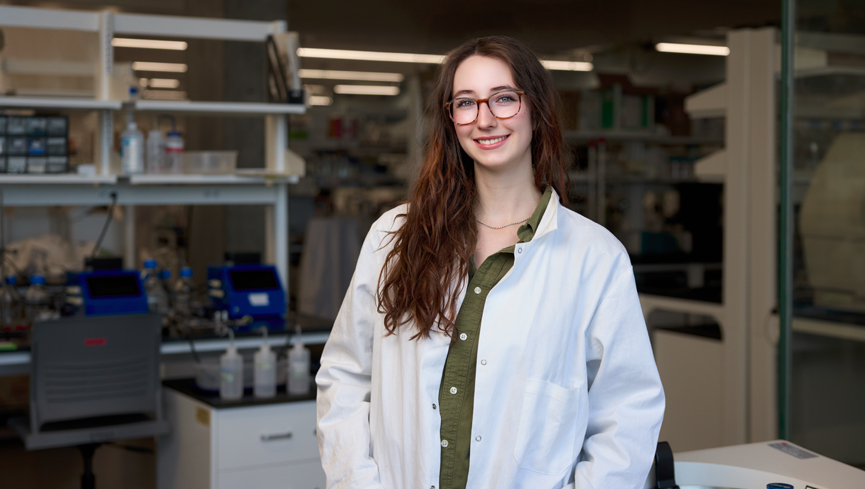
Pharmaceutical companies use the AUC to assess the purity of their vaccine formulations during development. Bird and the research team, working under the supervision of Dr. Borries Demeler, developed a new technique to measure the purity. Purity is critical in vaccine development because contaminants can reduce effectiveness or trigger unwanted immune responses.
“The method and software we created to analyze the data are really novel because they can identify contaminants that other methods were unable to detect,” she says. “This ultimately helps pharmaceutical companies and researchers create pure vaccine products.”
“The success of this research reflects a powerful convergence of student excellence, unique infrastructure and strong industry collaboration,” says Demeler, professor in the Department of Chemistry & Biochemistry. “At its core is the exceptional academic ability, biophysical research skill and dedication of our students — exemplified by Sophia — who work at a level comparable to researchers at much larger institutions while tackling critical challenges in biomedicine.”
The achievement was made possible with the support of AUC Solutions, ULethbridge and a MITACS grant.
“It’s an incredible experience as an undergraduate student to become a first author on a paper, especially in such a prestigious journal,” says Bird, a fourth-year biochemistry student. “Being a first author means that I had a significant role in designing the experiment, writing the paper and collecting and analyzing the results. I had the opportunity to collaborate with a lot of great people who helped me understand the system, improve my research and interpret the results.”
Being first author on a research paper will help Bird with applications to graduate school and show future employers that she’s capable of leading a research investigation and collaborating with scientists at other institutions. In Bird’s case, it has also helped her land a six-month internship with Roche, a health-care biotech company, at their facility in Penzberg, Germany.
“I have the opportunity to go there and work in their gene therapy department and teach them some of the AUC techniques I use here and work in tandem with their researchers who are developing new vaccines,” she says.
Bird’s path to this achievement began in high school through iGEM, where Dr. Laura Keffer-Wilkes introduced her to wet lab research. Since then, she has completed multiple independent studies, worked with international collaborators, attended conferences and workshops, and even spent a semester at a research lab in Christchurch, New Zealand. Following her internship at Roche, Bird is looking at graduate studies.
For Bird, the publication marks both a milestone and a beginning. As she prepares for her next steps, her work stands as a reminder of what young scientists can achieve when curiosity meets opportunity — and of the vital role ULethbridge plays in nurturing that potential.