
Two University of Lethbridge physicists are among the scientists in a Canada-wide collaboration focused on gravitational-wave (GW) astrophysics that has received infrastructure funding from the Canada Foundation for Innovation (CFI).
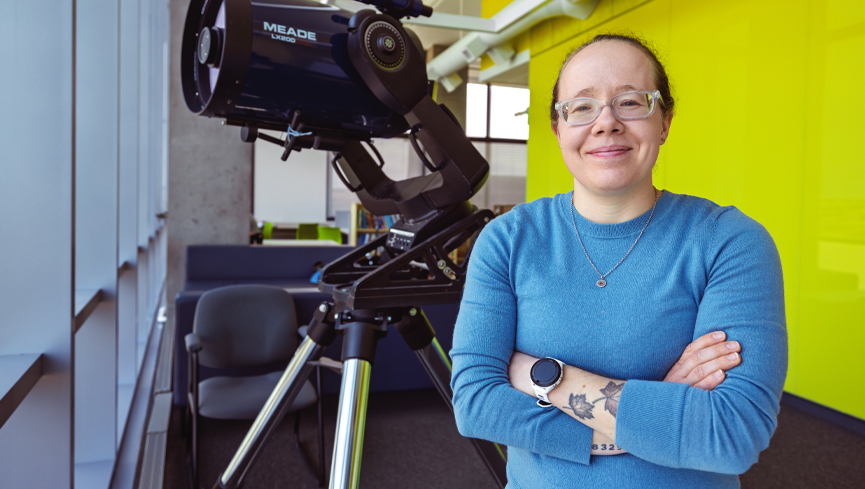
The Government of Canada announced $552 million to provide researchers with the high-impact equipment they need for innovation. The funding supports 92 research infrastructure projects at 32 post-secondary institutions, including work from ULethbridge's Dr. Saurya Das, a theoretical physicist, and Dr. Alex Tetarenko, an astrophysicist.
ULethbridge is part of GRAIN (GRavitational wave Astrophysics Infrastructure Network), which also includes the University of British Columbia, McGill University, Université de Montréal, Bishop’s University and the University of Manitoba. GRAIN will contribute to two international mega-projects that will unveil distant black holes and enable precise tests of theories that push the boundaries of physics.
Gravitational-wave astrophysics is the study of ripples in spacetime generated when massive objects like black holes collide. Studying these ripples gives scientists insights into the structure and dynamics of the fabric of the universe.
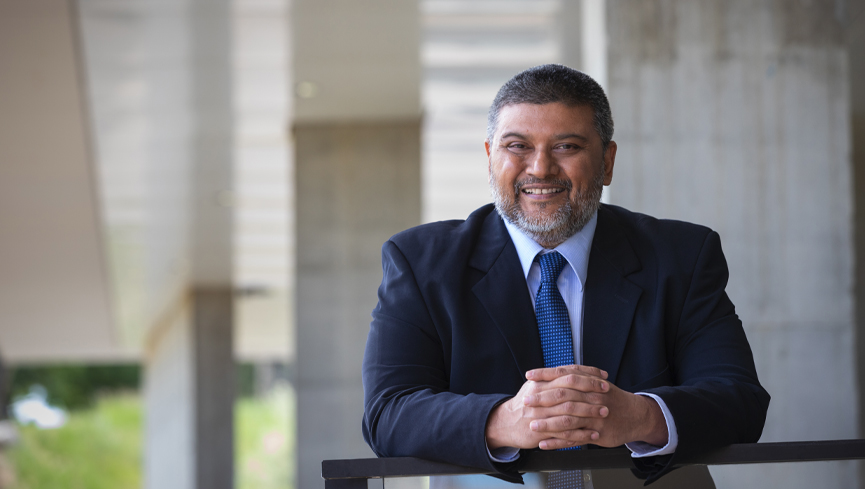
“The University of Lethbridge plays a pivotal support role in ensuring Canada’s software readiness,” says Das, a theoretical physicist in the Department of Physics & Astronomy at ULethbridge. “My colleague, Dr. Tetarenko, and I will help develop GRAIN’s software and participate in data analysis, as well as coordinate with our national partners to obtain the high-performance computing resources we need.”
They’re also looking at hiring a developer to build and maintain the interface between Canada’s Arbutus supercomputing cluster and a new Canadian LISA data centre.
“By combining innovative hardware, sophisticated software and strong international partnerships with the European Space Agency, GRAIN will ensure that Canada remains at the forefront of gravitational-wave astronomy,” says Das.