
For most people diagnosed with Alzheimer’s disease, moving into a care facility becomes necessary at some point. Such a big change disrupts all aspects of a patient’s life, including their social life.
These changes to their social network have been associated with increased cognitive decline and memory loss; however, the reasons for this association are not well understood.
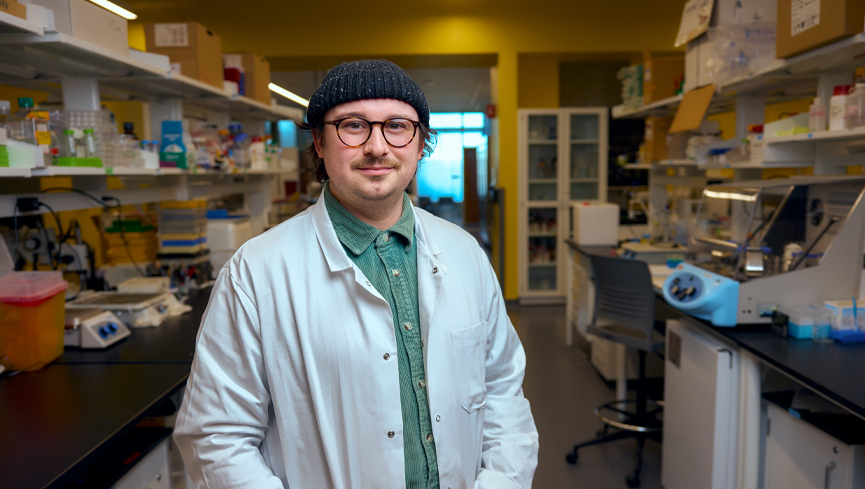
Dr. Jackson Ham (BSc ’19, MSc ’21, PhD ’25), a postdoctoral fellow in Dr. Rob McDonald’s lab at the Canadian Centre for Behavioural Neuroscience at the University of Lethbridge, has received $150,000 in funding from the Alzheimer Society of Canada to learn more about the association between cognitive decline and disruption to someone’s social network.
Using a mouse model, Ham seeks to understand what’s happening to neurons inside the brain when the social group is stable and when it’s unstable, and how that affects mood and behaviour.
“Mood changes and feeling anxious or depressed are often reported when people with Alzheimer’s or dementia move into a care facility,” says Ham. “That’s definitely one of the things we’re going to be investigating.”
To simulate social network disruption, aged mice and mouse models of dementia will be kept in either stable or unstable social groups. Mice in the unstable groups will be housed with new cage mates every three days, while mice in the stable groups will stay with the same cage mates.
Ham will test the memory, cognition and emotional regulation of both groups in real time to see what’s happening in the brain.
“This research will increase our understanding of the neural processes underlying cognitive decline and memory loss associated with social behaviours, but could also inform policy,” he says. “Humans are fundamentally social beings, and understanding the importance of the social network for those with dementia could help us optimize the care facility environment to slow the progression of the disease.”
Apart from moving into a care facility, changes in a social network often happen naturally as people age. One’s spouse may pass away, or one can no longer drive, or longtime friends move or pass away. Knowing how these experiences can change mood, behaviour, and the progression of Alzheimer’s disease could ultimately lead to better treatments and programs. The research is becoming increasingly relevant as cases of dementia in Canada are projected to be around one million by 2030.
The study is underway, and Ham expects to have results by early 2027.
The Government of Canada’s Research Support Fund is an important source of funding that supports the University of Lethbridge’s research enterprise, including maintenance and operations of research facilities, administrative staff salaries, and workplace health and safety training. This research was conducted within the Rodent Research Facility and supported by Animal Care Services, both of which are supported by the Research Support Fund.