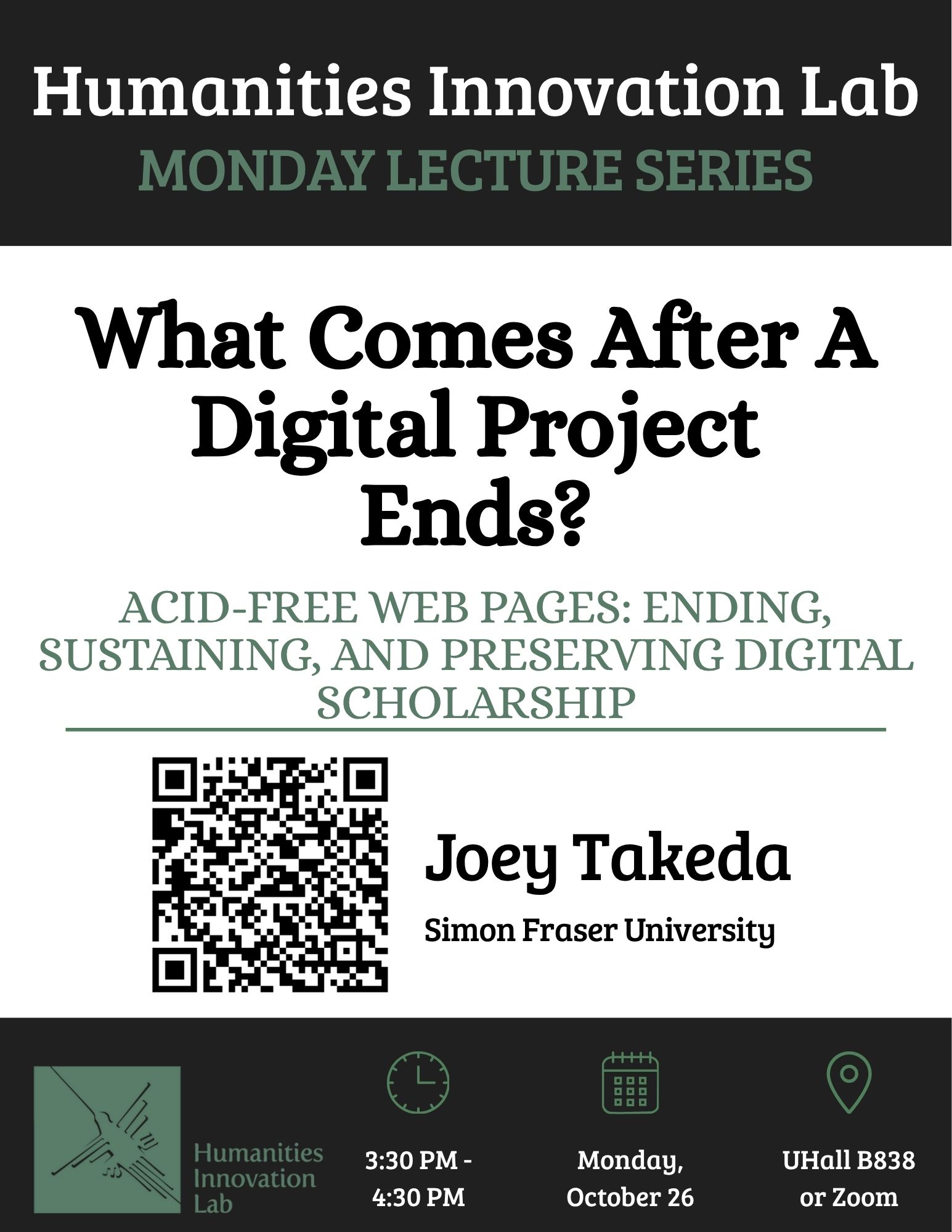
While initiatives and standards like the Endings Project have demonstrated approaches for creating preservable projects, the “danger of disappearance,” to use Amy Earhart’s term from Traces of the Old, Uses of the New (2015), remains a central concern within the digital humanities. Not only do digital projects remain vulnerable to changing technologies and shifting institutional priorities, their longevity is hardly guaranteed. Growing investments in national and international infrastructures for preserving and sharing research outputs suggest promising possibilities for preserving DH, but it remains challenging to reconcile the unique concerns and shapes of DH projects with the necessarily broad infrastructures for preserving and sharing research. In other words, even when a DH project is built sustainably, how, when, and where do we archive it?
In this talk, Joey Takeda thinks through “sustainability” across multiple registers to ask what we mean, and on whom we depend, when we invoke “sustainability”—as well as allied terms like "reproducibility" and "replicability"—in our discussions of preserving, archiving, and sharing digital scholarship. Beginning with the Endings Project and drawing on recent work from Simon Fraser University's Digital Humanities Innovation Lab, this talk outlines approaches for creating not only sustainable digital projects but also pathways for sustaining them in the long-term. Ultimately, this talk hopes to underscore both the shared and distinct interests of digital humanities with more general digital research infrastructure and reiterate the need for strong connections between the digital humanities, the library, and archives.
To register for Zoom https://us06web.zoom.us/meeting/register/i3vi6G-hRhuOG5F3BRgCSQ#/registr...
Contact:
Rachelle Wiebe | rachelle.wiebe@uleth.ca | 403-329-2378